Sorry I've been gone! I've been reading, I've just been lazy about writing things. Anyways, from the title you'd be thinking that there's a lot of Neil Gaiman love going on in my life lately... Well, not really. I thought this was going to be a full-blown sequel to American Gods (ugh, how embarrassing, but this makes me want to read it again...), so I was little disappointed. There's a novella sequel to it, but reading a lot of Stephen King has spoiled me in the sense that I was expecting the novella to be about 150 pages longer... (55 pages!?) I also... Well, Neil Gaiman's short stories aren't really my thing, or at least they don't appeal to me as much as his longer stuff. The shorter stuff... A lot of the stories feel like they're lacking something, even when they are good. So I admit that I skipped more than a few (also the poetry) and I peaced out halfway through some because I got bored. (Sorry.) Oh, and I thought this was the collection of short stories with the original "Murder Mystery" story adaptation too, sooo...
The first story I did just plain skip--it was a Sherlock Holmes-style story, "A Study in Emerald"--a parody of "A Study in Scarlet". I hate Sherlock Holmes. I love the show, but the books are too dry for me, and in print, Sherlock always seems like an insufferable, arrogant jerk (Cumberbatch can get away with that because he's gorgeous and has a voice like Alan Rickman). I tried to give it a go, but it got to the "Rache"--an exact scene lifted from the Holmes story--and I was done.
So! The first thing I have anything to say about is "October in the Chair". This story was dedicated to Ray Bradbury, who, as you probably know, just recently passed away. Anyways, this story was written long before that, so... The basic premise is that all the months, personified (with pretty accurate characterizations, I think) meet once a month (I believe) and tell a tale. You only see about two stories, which is what disappointed me about this one. Maybe every month telling a story would be tedious, but... At least like... three? Four? One whole season or... Well, anyways, October tells us a story of a looked-over boy who runs away because he is sick of being ignored. After much travelling, he makes friends with a ghost, and decides he'd rather stay with his ghost friend than be found. So his ghost friend directs him to a house where "they" (different beings) live, who might enable him to stay... Implying that they'd kill him. And it ends with him still outside and hearing a noise inside the house. A good story... but it felt malnourished. Probably my favourite in the book, though. I wonder what Bradbury had to say about it?
The next story was "Forbidden Brides of the Faceless Slaves in the Secret House of the Night of Dread Desire"... I zoned out during this one. What I did note, though, is that a young author who is frustrated by his inability to write what he wants well is visited by a talking raven. This was written after Sandman--and although it's a connection to Poe too, one can't help but think of Matthew, Dream's feathered companion.
Another story, "Closing Time". Again, it seemed interesting--a man tells a story of an event that happened when he was a boy, there's a bit of a mystery--he went to a strange playhouse, or hut, as I imagined it. Very, very condensed version is that he went with three older, boisterous boys, they come in, never come out, and he returns home. Creepy on its own, good, but the framing device which returns at the end hurts it and just serves as a distracting factor.
The perfect story in this collection--and my actual favourite--is "Other People". At first I didn't get the title, exactly, but I realized pretty quickly (though you won't really understand it till the end) that it was a play on that saying, you know, that "hell is other people". It is so good that I have provided you with a link. It takes about five minutes to read. (I wonder what happens to the old demons after...?)
I swear I've read "The Facts in the Case of the Departure of Miss Finch". I know I have--from the very start, I was sure I knew it. I was less sure about the very end, but I was sure that I've seen it, or a very similar story, somewhere before... (Cirque du Freak? Petshop of Horrors?) Anyways. That was my statement, and this: "She curved like a Raymond Chandler smile" (Gaiman 143). Could you tell that this story was written in 1998? I was dying.
Oh OKAY. The next story I have notes on is "The Problem of Susan". Neil Gaiman said he wrote this because the treatment of Susan in the Narnia books always bothered him. Understandable, but... Susan was a bitch. Her and her nylons, and invitations... I mean, really! Anyway, the story goes on--some people aren't sure if the old professor is just some lady who knows fantasy lit, or the actual Susan. I think it has to be Susan. A young girl interviews her on "the problem of Susan" (why her siblings went to paradise while she alone remained on earth and didn't receive the touch of the divine paw, so to speak), and as the girl describes it, the old professor (who is the right age) describes the same situation from a personal view... She talks about identifying the bodies (Remember, the Pevensie children die in a train crash at the end of The Last Battle!)... She specifically says Ed! Edmund, of course! (Edmond?) She even says that there's no way that a god who would punish a girl who "lik[es] nylons and parties" (Gaiman 187) would be an entirely kind fellow--"'enjoying himself a bit too much, isn't he?'" (Gaiman 187). The people who read this and didn't realize that it was the Susan (married and divorced, husband died, etc--) weren't really paying attention at all. Anyways--it gets awkward after that, and Susan politely dismisses the interviewing girl for good.
Later that night, both women dream: Susan of a Mary Poppins book that the author never wrote while living (Sandman again, Lucien's library!), and the young girl interviewing (Greta, and okay, in her mid-twenties) dreams too--and um, be warned. It's gross, in a deeply disturbing way. I have never felt nauseous from just reading something--this changed that. Here:
"She is standing on the battlefield, holding her sister's hand... The witch looks at them all, then she turns to the lion, and says, coldly, 'I am satisfied with the terms of our agreement. You take the girls: for myself, I shall have the boys.' She understands what must have happened, and she runs, but the beast is upon her before she has covered a dozen paces. The lion eats all of her except her head... She wishes that he had eaten her head, then she would not have had to look. Dead eyelids cannot be closed, and she stares, unflinching... The great beast eats her little sister more slowly, and, it seems to her, with more relish and pleasure than it had eaten her, but then, her little sister had always been its favorite. The witch removes her white robes, revealing a body no less white, with high, small breasts, and nipples so dark they are almost black. The witch lies back in the grass, spreads her legs. Beneath her body, the grass becomes frost. 'Now,' she says. The lion licks her white cleft with its pink tongue, until she can take no more of it, and she pulls its huge mouth to hers, and wraps her icy legs into its golden fur... Being dead, the eyes in the head on the grass cannot look away. Being dead, they miss nothing. And when the two of them are done, sweaty and sticky and sated, only then does the lion amble over to the head on the grass and devour it in its huge mouth... The white witch rides naked on the lion's golden back. Its muzzle is spotted with fresh, scarlet blood. Then the vast pinkness of its tongue wipes around its face, and once more it is perfectly clean'" (Gaiman 189-190).
Yeah. So. I'm thinking the message is that no-one is just plain good and perfect, and no-one is just plain evil, and they get mingled in all sorts of ways. But honestly, I don't want to think about this story too much.
"Fifteen Painted Cards From a Vampire Tarot" was pretty intriguing too. It was made up of several shorts wed together, and each short was enough so that it didn't need anything more. I know that's weird, compared to what I've been complaining about, but it works... I mention it mostly because it hints at that popular notion that Jesus was a vampire--well, maybe popular isn't the right word, but it crops up from time to time, and more than you think. (The idea comes from the "this is my blood, this is my body...", the fact that Jesus came back from the dead... One story I read implied that this is why Dracula--because Dracula was that vampire in question in the story--feared the cross, because his original death had taken place on it... Oh, and because of the eternal life promised--"[Christianity] was the only religion that delivered exactly what it promised: life eternal for its adherents" [Gaiman 211].) Soooo yeah.
"In the End" was really cool, too. It plays on the idea of entropy--at least I believe the concept is entropy, forgive me if it isn't, the last astronomy class I took was two years ago--but the idea that I'm thinking of is that, instead of the world ending just like that, the world reaches a certain point... and then things run backwards. You live your life backwards. Everything in the universe runs backwards, until the big bang, and then some people think it goes back, or it keeps on running backwards into nothingness like that. Well, "In the End" plays on that with a religious twist. You'll see what I mean when you read it. (If you Google it, there's a free .mp3 of it online, but I don't really like it read...)
"How to Talk to Girls at Parties" is mentioned just because two teenaged boys go to the wrong party and I think one of them almost accidentally has sex with a space alien. Or something? My attention for this book in general was going at this point, but also they mention David Bowie twice in this story, and that's pretty cool.
And the novella that's a sequel to American Gods--I haven't a terrible amount to say about it. I guess my feelings on this whole thing are mainly negative, and I feel bad about that because I really do like Neil Gaiman, but this collection just wasn't my thing. Anyways, the only thing I have to mention about it is that it's set two years after the novel, and Shadow reflects on this, saying that he is 35 now. Now, in the actual book, Shadow dies and comes back reminiscent of a Norse god--the god Odin, in fact. He was hung on a tree and even stabbed in the side. And then Odin comes back. Early people hoping to make converts out of Norsemen connected him to Jesus as one way to make Christianity more appealing or more familiar. So! If it was two years ago, Shadow was 33 then. Jesus was supposedly 33 1/2 when he was crucified and subsequently resurrected. So... So yeah! Wooh, connections.
My other note is that it features a character named Mr Alice, who appears in one of the earlier stories of this collection...
So yeah... That's it. This book wasn't for me, but maybe it'll be for you! Good night!
MLA Citation Information: Gaiman, Neil. Fragile Things. William Morrow: United States of America, 2006.
Showing posts with label American Gods. Show all posts
Showing posts with label American Gods. Show all posts
Tuesday, June 19, 2012

Thursday, April 29, 2010
Shrimp of Destiny
Well, for my Wizards class we had to finish Pawn of Prophecy by David Eddings. There was half a test on it on Wednesday (which Marky Mark probably warned us about but I obviously wasn't paying attention) which I probably got a .007 on. Which is still kind of cool because, I mean, I got a James Bond on a test. Haha, you might even say I James bombed that test! HAHAHAHAHAHA oh God, I'm too much. Really, I am. Seriously. Anyway, the second part of the test, the essay, is tomorrow, so I figured that maybe doing my little blog post about it would help.
Well, let's see. This is your basic main character is a child of prophecy to stop something evil and it turns out his caretaker knows and stuff and can use magic and then they go on a quest. Also, the kid is actually a young David Bowie. http://ecx.images-amazon.com/images/I/515R415NG1L.jpg Actually, to sum up the whole story--you've seen the movie Labyrinth starring David Bowie, right? Well, this is kind of a prequel. You see, David Bowie--Jareth--is set to destroy the original goblin king, Torak, but it's revealed--at the end of the series, of course--that to kill him you automatically take his spot. You kind of... inherit his mantle, if you will. So, unwillingly he takes his throne, and the epilogue is x years later, and an introduction to the cult movie.
Guys. Guys. Did you believe all that? I'm kidding. Did I actually fool you? It's more convincing when I do it in person. I've mastered Jedi mind control, you know? This isn't the blog you're looking for. No, no! Just kidding! This is the blog you're looking for! And the one you recommend to all your friends, because it is so freaking awesome.
What it's actually about--well, all that stuff before I said Garion is a young David Bowie is pretty much true. But you have to admit, he's a dead ringer for Bowie, no? There's a brief introduction about the gods, namely the 'evil' god, Torak. At the beginning of time (or some time close to that) he stole and abused the Orb of power, and it melted down half his face. Like Two-Face. Anyway, he wants his glory and power and stuff back, so he's going to try and reclaim it at some point after this first book (I wasn't lying about it being a series, either). And... there are certain people who can use the globe without their faces getting boiled and they have a special birthmark which--surprise surprise!--Garion has.
First of all, this dedication is very sweet. "For Theone, who told me stories but could not stay for mine" (I).
"'Who's to say what's only a story and what's truth disguised as a story?'" (33).
"'That's impossible,' Garion said. 'Is it? How old are you?' 'Nine--next Erastide.' 'And in nine years you've learned everything that's both possible and impossible? You're a remarkable boy, Garion'" (33). How Jane Austen of you, David Eddings! Haha.
Oh, and I just want to throw a spoiler in here. The person who admonished Garion in the last quote is Mister Wolf. Garion is taken care of by his 'aunt', Pol. Now, midway through the book it is revealed that Mister Wolf is Aunt Pol's father--a fact that sent me reeling completely. There's definitely tension between her and Wolf, but it's sexual tension. Seriously, you do not get the feeling they're father and daughter at all. Just thought I'd bring that up.
"Zubrette, of course, did not grow so tall, but she developed in other ways which the boys began to find very interesting" (48). HAHAHA. Eddings has little hilarious asides all the time, and they're almost always this kind of humor. Humor is quite rare in fantasy books, apparently, as the creator usually takes their made-up world rather seriously, but Eddings seems to be a little looser with it. I'm sure he takes his made-up world seriously, just not to the point of letting it be stiff. Though, Marky Mark has said after a while the humor of the Pawn of Prophecy's series gets tiresome, because it's that same basic type. Well, I only read the first book so whatever.
"Barak pulled off his tunic. His torso was enormous and covered with thick red hair. 'You look like a rug,' Silk observed. 'I can't help that,' Barak said. 'Winters are cold in Cherek, and the hair helps me stay warm'... 'Are you absolutely sure your grandmother didn't dally with a bear during one of those long winters?'" (84). Again, I literally burst out laughing.
"'They have a stern and demanding God,' Wolf replied. 'Which God is that?' Garion asked. 'Money,' Wolf said. 'Money's a worse God than Torak himself'" (90). This reminds me of Neil Gaiman's book American Gods. Certainly there was a god dedicated to money in the book, but I don't remember s/he or it clearly. However, this makes me think of when Shadow is talking to the god/dess of television. S/he says that people make sacrifices to him/her all the time, though they're not traditional sacrifices, and Shadow asks what they are. She responds with "'Their time, mostly... sometimes each other'" (American Gods, 175).
"'I didn't go to all the trouble of raising you to have you end up dead in a gutter'" (125). Wow, Aunt Pol, that's a little... well, it's no wonder you haven't gotten married or had kids of you're own. You're a little blunt, aren't you?
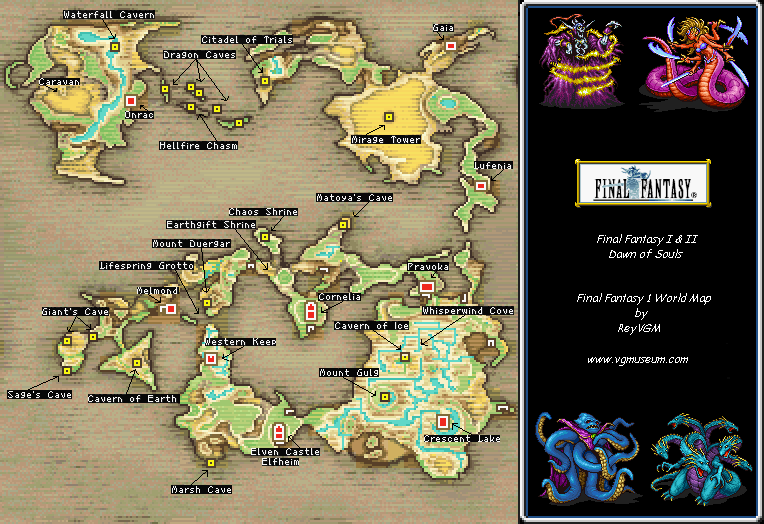
On page 176 of this edition of the book (which I assume is the most recent edition of the book; in any case it is the one with the cover I provided the link to) there is a map of Cherek. Now, who here has played the first Final Fantasy? Well, in it you have to blow up a land mass to get out of a landlocked sea. The thing you blow up is near the arrow pointing to the Lifespring Grotto--though in this the piece you must destroy is already gone. Rest assured, the maps are ridiculously similar (though the almost landlocked sea that borders Cherek's innards is much smaller).
Well.... Yeah. I guess I don't have a lot of insight on this, which is why I'm going to fail the test on it tomorrow. Hooray, I love having to take finals! It's a pretty good book. I'm thinking I'd like it more if I was ten or eleven, but then again, I wouldn't understand Eddings's fourteen-year-old boy humor if I had read it then... Anyway, I would be interested in reading the rest of the series, but I won't actively pursue it. If it came into my possession by chance, or if I happened to find it on sale or something, I'd get it, but I'm not going to go crazy over trying to find it.
Let's see, yesterday I happened to be weeding through lots of crappy fantasy and sci-fi books. One that I looked over (though I now regret, because on reflection, I seriously want to know what the hell it was about) had on the cover a huge spaceship with a bit of a grassy hill in the foreground. There was a man on the hill, too. It was a Roman hoplite yelling as if he was about to attack and similarly poised as if about to do so. I wonder what that book was about. I really do.
PS. On one of the pages I took notes for the book on, I accidentally referred to the book as 'Prawn of Prophecy'. Hence, the blog title.
Well, let's see. This is your basic main character is a child of prophecy to stop something evil and it turns out his caretaker knows and stuff and can use magic and then they go on a quest. Also, the kid is actually a young David Bowie. http://ecx.images-amazon.com/images/I/515R415NG1L.jpg Actually, to sum up the whole story--you've seen the movie Labyrinth starring David Bowie, right? Well, this is kind of a prequel. You see, David Bowie--Jareth--is set to destroy the original goblin king, Torak, but it's revealed--at the end of the series, of course--that to kill him you automatically take his spot. You kind of... inherit his mantle, if you will. So, unwillingly he takes his throne, and the epilogue is x years later, and an introduction to the cult movie.

Guys. Guys. Did you believe all that? I'm kidding. Did I actually fool you? It's more convincing when I do it in person. I've mastered Jedi mind control, you know? This isn't the blog you're looking for. No, no! Just kidding! This is the blog you're looking for! And the one you recommend to all your friends, because it is so freaking awesome.
What it's actually about--well, all that stuff before I said Garion is a young David Bowie is pretty much true. But you have to admit, he's a dead ringer for Bowie, no? There's a brief introduction about the gods, namely the 'evil' god, Torak. At the beginning of time (or some time close to that) he stole and abused the Orb of power, and it melted down half his face. Like Two-Face. Anyway, he wants his glory and power and stuff back, so he's going to try and reclaim it at some point after this first book (I wasn't lying about it being a series, either). And... there are certain people who can use the globe without their faces getting boiled and they have a special birthmark which--surprise surprise!--Garion has.
First of all, this dedication is very sweet. "For Theone, who told me stories but could not stay for mine" (I).
"'Who's to say what's only a story and what's truth disguised as a story?'" (33).
"'That's impossible,' Garion said. 'Is it? How old are you?' 'Nine--next Erastide.' 'And in nine years you've learned everything that's both possible and impossible? You're a remarkable boy, Garion'" (33). How Jane Austen of you, David Eddings! Haha.
Oh, and I just want to throw a spoiler in here. The person who admonished Garion in the last quote is Mister Wolf. Garion is taken care of by his 'aunt', Pol. Now, midway through the book it is revealed that Mister Wolf is Aunt Pol's father--a fact that sent me reeling completely. There's definitely tension between her and Wolf, but it's sexual tension. Seriously, you do not get the feeling they're father and daughter at all. Just thought I'd bring that up.
"Zubrette, of course, did not grow so tall, but she developed in other ways which the boys began to find very interesting" (48). HAHAHA. Eddings has little hilarious asides all the time, and they're almost always this kind of humor. Humor is quite rare in fantasy books, apparently, as the creator usually takes their made-up world rather seriously, but Eddings seems to be a little looser with it. I'm sure he takes his made-up world seriously, just not to the point of letting it be stiff. Though, Marky Mark has said after a while the humor of the Pawn of Prophecy's series gets tiresome, because it's that same basic type. Well, I only read the first book so whatever.
"Barak pulled off his tunic. His torso was enormous and covered with thick red hair. 'You look like a rug,' Silk observed. 'I can't help that,' Barak said. 'Winters are cold in Cherek, and the hair helps me stay warm'... 'Are you absolutely sure your grandmother didn't dally with a bear during one of those long winters?'" (84). Again, I literally burst out laughing.
"'They have a stern and demanding God,' Wolf replied. 'Which God is that?' Garion asked. 'Money,' Wolf said. 'Money's a worse God than Torak himself'" (90). This reminds me of Neil Gaiman's book American Gods. Certainly there was a god dedicated to money in the book, but I don't remember s/he or it clearly. However, this makes me think of when Shadow is talking to the god/dess of television. S/he says that people make sacrifices to him/her all the time, though they're not traditional sacrifices, and Shadow asks what they are. She responds with "'Their time, mostly... sometimes each other'" (American Gods, 175).
"'I didn't go to all the trouble of raising you to have you end up dead in a gutter'" (125). Wow, Aunt Pol, that's a little... well, it's no wonder you haven't gotten married or had kids of you're own. You're a little blunt, aren't you?
On page 176 of this edition of the book (which I assume is the most recent edition of the book; in any case it is the one with the cover I provided the link to) there is a map of Cherek. Now, who here has played the first Final Fantasy? Well, in it you have to blow up a land mass to get out of a landlocked sea. The thing you blow up is near the arrow pointing to the Lifespring Grotto--though in this the piece you must destroy is already gone. Rest assured, the maps are ridiculously similar (though the almost landlocked sea that borders Cherek's innards is much smaller).
Well.... Yeah. I guess I don't have a lot of insight on this, which is why I'm going to fail the test on it tomorrow. Hooray, I love having to take finals! It's a pretty good book. I'm thinking I'd like it more if I was ten or eleven, but then again, I wouldn't understand Eddings's fourteen-year-old boy humor if I had read it then... Anyway, I would be interested in reading the rest of the series, but I won't actively pursue it. If it came into my possession by chance, or if I happened to find it on sale or something, I'd get it, but I'm not going to go crazy over trying to find it.
Let's see, yesterday I happened to be weeding through lots of crappy fantasy and sci-fi books. One that I looked over (though I now regret, because on reflection, I seriously want to know what the hell it was about) had on the cover a huge spaceship with a bit of a grassy hill in the foreground. There was a man on the hill, too. It was a Roman hoplite yelling as if he was about to attack and similarly poised as if about to do so. I wonder what that book was about. I really do.
PS. On one of the pages I took notes for the book on, I accidentally referred to the book as 'Prawn of Prophecy'. Hence, the blog title.
Thursday, September 3, 2009
Before there was rock, you only had god
Oh lookie here, I'm reviewing (or whatever you'd call theses posts) American Gods by Neil Gaiman! It was a really good book, but it slowly lost steam over time. You see, it starts out this man Shadow is just let out of prison but his wife has been killed. Having nothing to go back to, he heads off with a man named Wednesday who offers him a job. You find out pretty quickly that Wednesday is deeply in touch with the supernatural world, and he himself is a god, or part of one. Anyways, during the first three-quarters or half or something like that in the book, Wednesday and Shadow travel across America in an attempt to gather the 'old' gods that have moved there over the years. You know, Czernabog, the Norse gods, Mama-ji, Bastet, Anubis.... The reason why they were being gathered is to go in a final war to defeat the 'modern' gods--gods of television, of automobiles, of media, what people generally worship nowadays and sacrifice things to. "Time... Sometimes each other."
So, some notes before I start which probably don't matter to anyone but me. But I'm the one writing this blog so ahaha.
Low Key--I was so embarrassed I didn't get the pun until Shadow realizes it. I don't know that much about Norse mythology, true, but still I know the names, and gahhh it bothers me.
This relies heavily on Norse mythology so that was new and exciting, for the most part. I know about Yggdrasil and the dragon and the red squirrel (I've always imagined him to be more ill-tempered), so I got all excited when towards the end they tied Shadow up, but other than that, all I have is very rudimentary knowledge--you know, Loki's the trickster, Thor has a mighty hammer, the Valkyries and Valhalla but nothing really solid, like how I can snap out Greek or Egyptian mythology like I was raised on it.
Czernabog--Until the very last time he appeared in the book I couldn't figure out how to say his name, and therefore couldn't figure out who the hell he was, and it was driving me absolutely bonkers. It's pronounced Chernabog--Apparently he's Slavic in origin, but I know him from Disney's movie Fantasia. You know, 'A Night on Bald Mountain'? Ayup, that's him. After figuring it out, though, it was hard to imagine him as the old Yiddish-sounding man from the book. And, for those of you who haven't seen Fantasia, ever played the first Kingdom Hearts? Final boss before Ansem.
One thing I liked was, that although Bacchus is mentioned in passing, no Greek gods are really present. They're still pretty popular, I mean, we still learn about them in school. So arguably, while they're not being worshiped, they're at last being remembered.
"'Tell him that we have f*cking reprogrammed reality. Tell him that language is a virus and that religion is an operating system and that prayers are just so much f*cking spam.'" What a cool quote, disregarding the excessive swears. (Well, he was threatening death, and I guess when you threaten death you don't bleep a thing out...) I think William S Burroughs said something to the exact affect of "Language is a virus." Oh, here it is--"Language is a virus from outer space." I like that one.
"'Gods die. And when they truly die they are unmourned and unremembered. Ideas are more difficult to kill than people, but they can be killed, in the end.'" First, made me think of V for Vendetta, of course. Second, it's the truth. A dying god is spit upon and laughed at and chided, so obviously being false and unreal compared to the new god and the new ideals that are golden and shiny for another few thousand or hundred years... A dead god is the skeleton of what's left. Too old, too gross, too strange to be sympathized with or respected anymore.
"'Liberty,' boomed Wednesday, 'is a bitch who must be bedded on a mattress of corpses.'" Evil and horrendous as it seems, as much as you'd like to avoid it or ignore it or tell yourself there's a better way (and there most likely is) blood is the most effective way to pay for anything; to get anything. Maybe you think I'm cold-hearted for that, but go on, think about some wars, and what they were for. And no, I don't know how to apply that to our current war. It's the difference between believing something is true and fully accepting it to the end--think Rorschach thinking the bombing of Hiroshima was a good thing as a child, and then the end of the book.
"'I read some books about brains,' she said... 'It was like, how five thousand years ago the lobes of the brain fused and before that people thought when the right lobe of the brain said anything it was the voice of god telling them what to do. It's just brains.' 'I like my theory better,' said Shadow. 'What's your theory?' 'That back then people used to run into gods from time to time.'" I like his better, too.
"A small boy sat inches away from the television set, a video of the Disney Hercules playing, an animated satyr stomping and shouting his way across the screen." It's got to be a little wink from Gaiman. I chuckled when I saw it. (The satyr in question is Phil, of course. What a good movie.)
Oh! And guess what! The mystery of Easter is explained. You know, how does coloring eggs and searching for them and bunnies and eating candy and stuff related to all the Biblical stuff? It's not! The name Easter derives from the German goddess Eostre, who was honored in the spring--for rebirth and life, like Jesus, but with her you get the candy and fun stuff. The coloring of eggs and bunny involvement, according to Wikipedia, are German customs. Sooo yeahhh. Not well known, I guess, because I have at least 9,000 mythology books and I've never heard of her.
"'You used to make jokes,' said Shadow. 'You don't anymore.' 'It's hard to find the jokes these days. Wednesday's dead.'" Sounds like a certain line from a certain comic book that Neil Gaiman allegedly had a hand in, hmm?
"'I offered you the world,' she said. 'When you're dying in a gutter, you remember that.'" / "What good will it be for a man if he gains the whole world, but forfeits his soul?" I want to say one of those apostles said that. Man, I need to just go through my Bible and highlight all the cool stuff so I actually can find these things. I want to say it's in Matthew, but I wouldn't take that without a grain of salt. Anyways, just pointing out the closeness, because at this point, you still think the 'new' gods are evil.
"'It's not what I'd want at my funeral,' said Mr. Nancy. 'When I die, I just want them to plant me somewhere warm. And when pretty women walk over my grave I would grab their ankles, like in that movie.'" I practically died laughing when I read this. He's talking about Carrie. X D
Poor Horus. In the book, you know, he can transform between a hawk and a man like the other Egyptian gods, and he transforms when all the gods are gathering for the final showdown--and he is described as acting awkwardly, having trouble speaking, focusing his eyes, even walking and standing. The goddess who sees him says or thinks something like "he spent too much time as a bird. He's forgotten how to be a man." Of course, you know who that made me think of. Poor Tobias, from Animorphs. He morphed as a hawk and got stuck in morph because he passed the two-hour time limit. Eventually he acquires himself(it's easier to just read the book than have me explain this), but he forgets how to make facial expressions, if he gets startled he jumps backwards frantically, flapping his arms, and much more. Poor Tobias, I love him.
I didn't quite get the Czernabog/Bielebog thing. I thought it meant Czernabog was kind of an Abraxas sort of god, capable of both good and evil, but Czernabog saw his different side as a whole different persona. A schizophrenic god, if you will. I don't like Wikipedia's explanation, that he 'changes with the seasons'. What? No shut up, that's dumb, and really weird. I don't see how it got to that conclusion.
So, I liked the book, but like I said, I was more into meeting the gods. It kind of started losing steam around (SPOILER) when Wednesday was killed, and by the time the fat kid turned out to be a robot I was just like THIS DOES NOT MAKE SENSE ANYMORE NEIL. ROBOTS CAN'T BRUISE. It didn't help that I was imaging the fat kid from Watchmen the whole time, haha. And then, flipping the plot around... The way he writes it, you never think, why can't these gods coexist? You just automatically think the new gods are the ENEMY ENEMY ENEMY. And when you realize at the end, when that's not the case, I think he actually handled it well. Any other author and I think I would've tossed the book out the window, but I was like ohh, the two-man deal. I like that Neil, I like that. So, 4/5? 3.5/5? Something like that. The one thing I didn't get was when Shadow meets the 'real' Odin. What I'm theorizing is maybe only a shred of him went to America with some of his followers--of course, not all of his followers went to the new world. But I'm not sure.
I was expecting Stardust to be your average child's fairy tale, right up to page 26, when a faerie and the main character's father have a one-night stand. So much for that... But. The rest of the book was simpler, and aside from that one sex scene, it would be your average OT book, or maybe even a middle school level book. Well, I guess I can't judge that well, since I read my first Stephen King and Michael Crichton books at age eleven. (7th grade.) But, all in all, it was a cute and mystical fairytale, nothing confusing and dramatic about it. Everything fit together, and although at some times the pieces felt awkward and rushed, they all formed a perfectly complete picture in the end. Though the end kind of annoyed me, when the Faerie girl's curse is broken--she turned out to be kind of a bitch. You think the curse would've softened her, or something. And the end end made me sad. But it's a good, quick read if you want to avoid a book with a twisting plot and you having to remember a million things so you can even pretend to know what's going on... well, here you go.
"'I am the most miserable person who ever lived'... 'You are young, and in love,' said Primus. 'Every young man in your position is the most miserable young man who ever lived.'"
"Have been unavoidably detained by the world." Neil Gaiman=awesome. I love this line. Love it.
Let's see, I started rereading Desperation and War of the Worlds, but they'll be put on hold till I finish Anthem by Ayn Rand, which Marky Mark demands I finish by Wednesday. (Which will hardly be any trouble at all.) And, tomorrow I'll be watching Catch-22, so look forward to that. Oh, and I rented 1408. Let's rollll.
Subscribe to:
Posts (Atom)