Woooo, yeah. Triple threat, right here. HP Lovecraft, my boy, famous horror author, apparently Stephen King's a big fan too. Just saying. (On the back he says "I think it is beyond a doubt that HP Lovecraft has yet to be surpassed as the twentieth century's greatest practitioner of the classic horror tale"! What I say to that? The twentieth century is over, Stephen King.)
This is a collection of Lovecraft's short stories, a lot of his shorter stuff, and probably contains more of his better-known works, cough cough LOOK AT THE ONE FEATURED IN THE TITLE. This is Cthulhu! You've had to at least have heard his name on the internet before, correct? He's a big thing there! (Here?) Well, in any case, if somehow you have not at least heard of him or are aware of Cthulhu's satirization, let me be the first to inform you that Stephen King is totally correct in saying HP Lovecraft is the best thing since Edgar Allen Poe. He's inspired a slew of science-fiction and horror authors since his earliest and continues to do so (Wha--me? Why are you looking at me? You guys are so silly) and he's famous if for nothing else the weird creatures he has created--since named the 'Cthulhu mythos'. (Also including, but not limited to, Yog-sothoth, Nylarthotep and Shub-Niggurath.) In any case, as I'm sure you've figured out, I'm a huge fan of the guy. What I'm trying to say is welcome to the biased post because Howard Philips Lovecraft isn't just for the win--he is the win.
The first short story is 'Dagon', which I hadn't read beforehand, except for the first line--in creative writing Marky Mark put together a sheet of stories/books with great opening lines that make you want to read more. This certainly has a great one, and I'd be doing you a disservice if I didn't share it: "I am writing this under an appreciable mental strain, since by tonight I shall be no more" (1). Yes? Awesome, no? (Others on the list were from Kafka's Metamorphosis and The Hobbit.) The story itself is based, as many of Lovecraft's are, on a nightmare Lovecraft had. The narrator of the story is captured on sea, but has the chance to escape on a lifeboat--which he takes. Exhausted and hungry, he passes into unconscious for several days until he awakes on a slimy stretch of land covered in rotting fish and strange sculptures and creatures. He realizes that the land (while still in his boat) is seafloor suddenly raised to the surface with no explanation, no time even for fish to escape the ascent to air. When the ground dries out enough to walk upon he wanders a ways to strange structures, sculptures--till he sees a beast, that is, Dagon. He then flees.
One thing that I thought was interesting, especially since it comes up many a time in the following stories of this collection, was the footnote attached to the narrator's comment about the 'putrid' scent of the dead fish. Apparently Lovecraft tended to include such detail because that would have stricken a powerful chord with him--he reviled seafood, certainly just the smell would sicken him as well. Perhaps why some of his creations were aquatic-dwelling or looked like aquatic dwellers, wearing tentacles, having fish-like visages, and so on? Mayhap?
The next story is also based on a dream of Lovecraft's. This story is 'The Statement of Randolph Carter'. Two men go on research to inspect a tomb--Warren and Carter. Warren goes in; Carter stays out, and while Warren is in he screams of how unbelievable it is, then suddenly urges Carter to leave. I actually really like the ending--perhaps it wasn't intended to be funny, but I cracked up. Have you ever heard the funny campfire stories, like a kid is confronted by a ghost with a horrible gash in its neck or something and it finally corners the kid that's tried to escape, but instead of killing him it asks for a band-aid? Well, it was kind of like that. I might as well spoil it--Warren's screaming eventually stops and Carter continues to call for him for quite a while till a shadowy creature confronts him and instead of harming him shouts: "'YOU FOOL, WARREN IS DEAD!'" (13). No? Not even a chuckle? Well, knowing that Warren is dead, it bothers me that earlier in the story (the bulk of the story is a retelling of the incident) Carter says he no longer fears Warren and his eccentricities, he now fears for him. Bro, he's dead. There's not much to worry about on his behalf now.
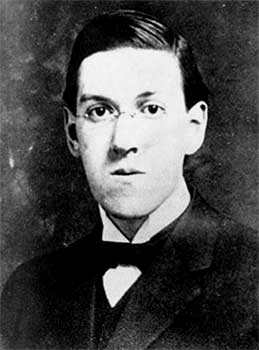
'Facts Concerning the Late Arthur Jermyn and His Family' is interesting because in some respects it's autobiographical of the Lovecraft family (except for the parts where the forebear of the family was wed to an ape from the heart of the Congo...). Madness struck several members of the Jermyn clan (as were father and mother Lovecraft, complications of untreated syphilis) and the other example that instantly jumps to mind is one regarding Arthur himself. As a boy Lovecraft apparently believed himself to be horrendously ugly, to the point of avoiding people or hiding rather than go out in public (and his mother in fits of madness didn't help; sometimes she would apparently cover his face in distress and beg people not to look at her "ugly" son). He's not that bad looking, jeez--though his wikipedia picture is less than flattering, for sure. Here's one--uh, is it just me or does he look like Stephen Colbert...? Well regardless Jermyn bore his actual ugliness well, he didn't mind his unfortunate visage because he was a "poet and scholar" (14). Oh, okay? Perhaps that's meant for Lovecraft to express another inadequacy he felt for himself? Well, I think you're both!
The next story that I've notes in is 'The Outsider', a story that the other American Lit class read and we didn't because ugh what a terrible class that was. This story contains a lot of the feeling one gets from Poe (unconscious but unsurprising; Lovecraft was a big fan) and is thought to have been drawn in some parts from Frankenstein and Oscar Wilde's short story 'The Birthday of the Infanta'. This story is considered to be many to be kind of half-baked--which yeah, it kind of is. The man (apparently risen from the dead for some unexplained reason) lives within a decaying castle of a sorts with no knowledge or memory of any others. Eventually he becomes fed up with this existence and becomes determined to break free--which he does. He travels to another castle nearby, and all those at the party there become horrified and flee from him upon viewing him. The creature doesn't understand it--until he's confronted with a terrible beast. He puts his hand up to protect himself--and much like the dwarf from 'The Birthday of the Infanta'--is stopped by glass--polished glass--a mirror.
"And at last I resolved to scale that tower, fall though I might; since it were better to glimpse the sky and perish, than to live without ever beholding day" (44). Words from the Outsider that turn terribly ironic at the story's end--was it really better? Certainly Wilde's dwarf would not agree; his discovery killed him.
'Herbert West--Reanimator' is HP Lovecraft's much better parody of Mary Shelley's Frankenstein. Herbert West is possessed by the same want to raise the dead. However, how he goes about doing it is almost completely opposite--for example, Frankenstein's monster is constructed over long periods of time from numerous bodies and only one is a success. Also, electricity is used to raise the beast. Or something. Herbert's corpses must be fresh, I believe twenty-four hours is cut-off point, to avoid a tainted subject because of decaying brain tissue. And even before then, it's pretty iffy. Also, Herbert uses a serum to bring them back. Herbert also has a companion all during this--whereas Frankenstein only has an Igor in adaptations. Their ends are the same however--Frankenstein is killed by his monster (if he could have done that 100 pages earlier, though...) and Herbert West is killed by his numerous 'successes'.
"Memories and possibilities are ever more hideous than realities" (50).
One thing I like is that the first success disappears--but that's not what I like, it's that the first chapter ends with the fact that from henceforth Herbert was forever paranoid of running into it again, and then "Now he has disappeared" (55). The first paragraph of the second chapter ends with "...a horror known to me alone now that Herbert West has disappeared" (55). I thought the reiteration was kind of cool, maybe showing that the narrator is half-mad because of the goings-on which I know, would be totally shocking. And also that that's all he can focus on because he observed the final moments--but no, according to footnotes, it is because this is a serialized story and that bit in the second chapter is just a quick summary from last month or last week's installment. Okay, fine. But this issue I must bring up again: like in 'The Statement of Randolph Carter', the narrator is all "I hope he's okay oh no he's missing that sucks" and I'm like "Dude, that monster-thingy told you he was dead! I don't think he'd lie." In this, even though the narrator (of course) faints he sees what happens to Herbert, Herbert is torn to pieces by the zombies. THERE'S NOT MUCH OF A QUESTION OF WHAT HAPPENED. There are "unidentifiable ashes" (80) in the furnace. He's not 'disappeared', he is in the furnace. Jeez.
The most horrifying scene is when they discover an undead creation with the arm of a child in its mouth. It is certainly the most chilling scene Lovecraft has ever written (though the imagination of the creatures from 'Pickman's Model' is a close second): "Looming hideously against the spectral moon was a gigantic misshapen thing not be imagined save in nightmares--a glassy-eyed, ink-black apparition nearly on all fours, covered with bits of mould, leaves, and vines, foul with caked blood, and having between its glistening teeth a snow-white, terrible, cylindrical object terminating in a tiny hand" (65). Ugh. Eek. Jeez. I think I'm going to be sick.
The writer of the explanatory notes makes an argument that the story was not influenced by Frankenstein, due to the differences I've outlined above. HP Lovecraft, in his letters are read, said the story is a parody. Sooooo yeahhhh.
'Rats in the Walls' at its beginning was kind of disappointing to me because I thought it was going to be that totally awesome Bram Stoker story (who names their kid Bram?) about rats that are in walls that's actually called 'The Judge's House'. It's really cool and I wish I owned some book that had it included. You should find it, unless horror isn't your deal. What the story is actually about is a guy (de la Poer) who moves into his ancestral home which is full of rats. Eventually, with the help of his cat--if you'll excuse me--'Nigger-Man' he discovers a huge underground city of his forebears who ate human flesh and raised humans down there specifically for slaughter.
The coolest part is the end. He goes mad upon discovering what he has and becomes possessed by the same latent attributes in him that drove his forebears and attacks his (human) companion and begins to devour him. Not only that, the narrator begins to rant and rave in the throes of his madness, devolving in language to unintelligable grunts: "Why shouldn't rats eat a de la Poer as a de la Poer eats forbidden things?... The war ate my boy, damn them all... and the Yanks ate Carfax with flames and burnt Grandsire Delapore and the secret... No, no, I tell you, I am not that daemon swinherd in the twilit grotto! It was not Edward Norrys' fat face on that flabby, fungous thing! Who says I am a de la Poer? He lived, but my boy died! ...Shall a Norrys hold the lands of a de la Poer?... It's voodoo, I tell you... that spotted snake... Curse you, Thornton, I'll teach you to faint at what my family do!... 'Sblood, thou stinkard, I'll learn ye how to gust... wolde ye swynke me thilke wys?... Magna Mater! Magna Mater! ...Atys Dhona 's dhola ort, agus leat-sa! ...Ungl... ungl... rrlh... chcchch..." (108). Awesome, huh? (After the Latin he speaks in Gaelic, then primitive grunts.) The explanation for the war ate my boy but not Norrys is that the two were both in WWI--the boy however was reduced to a cripple because of injuries sustained and died in two years. And the bit about the flabby fungous thing and all--him denying that he attacked and partially ate Norrys.
The biggest factor that takes away from the story is the cat's name. It's one of the most blatant elements of racism in any of Lovecraft's stories (though trust me, there's a lot, and for practically everybody that's not him). His intense racial prejudices are very unfortunate. Well, back to the cat's name--it certainly damages the story, even if just as a bothersome detail that's like woah... Come on, Lovecraft. Chill. (Even more bothersome would be perhaps that he named the cat of the story after one of his own cats, his favorite from his childhood.)
Ahhh, 'The Call of Cthulhu'! A story to have inspired countless other literary works, movies, videogames, and an episode of The Grim Adventures of Billy & Mandy! Cthulhu entrapped in the ocean though dead is not really dead and can send out psychic calls to the minds of men, resulting in outbreaks of madness--huh, KA Applegate... that sounds familiar. It's so strange, can't imagine why... Just this name, Aximili-Esgarrouth-Isthill... Weird, why would I think of that name, or book number four in the series on the cover of which Cassie is turning into a dolphin? Well, it's essentially about that and Cthulhu's followers rising as the great Old One is himself--and eventually being thwarted, though not forever, because the creature can never truly be defeated or killed, and will rise to bring madness and horror and destruction unto mankind once more... or however many times it takes to do so successfully. I really haven't much to say other than this is an awesome story, and Lovecraft pulls a Victor Hugo in describing Cthulhu--saying he's the beast that can't/must not be described, but mentioning his claws, squid-head, et cetera--like in Hunchback of Notre Dame when Victor Hugo's all "I won't even try to describe this specific detail of his being which will give you a clear idea of exactly what Quasimodo looks like actually". Sometimes when Lovecraft does it it gets a little hackneyed but compared to when Lovecraft actually does describe the being in mind--sometimes I wish he hadn't. Here's a passage that makes me particularly queasy (from 'The Festival'): "They were not altogether cpws, nor moles, nor buzzards, nor ants, nor vampire bats, nor decomposed human beings; but something I cannot and must not recall. They flopped limply along, half with their webbed feet and half with their membraneous wings; and as they reached the throng of celebrants the crowded figures seized and mounted them, and rode off one by one..." (116). Uheheh. I think I'm going to be sick. Again.
'The Colour Out of Space' interests me because of my knowledge of Stephen King's affection for Lovecraft and the fact that King did the screenplay for the movie Creepshow. The Lovecraft story is about a once-prosperous farm. A mysterious meteor crashes into the land beside the barn and strange things begin happening, crops begin giving off tasteless fruits, otherworldly plants begin to grow, family members go mad, and even the livestock suffers. The color regards the strange colors that spread and pulse over the land and in the growths that has come from the meteorite. Okay, okay. The movie Creepshow is set up in five different stories, and the second (or third, if you count the introduction) is about a fellow who finds a strange meteor. The meteor causes intense vegetation to crop up, including all over the secluded hick farmer who found it. The bit ends with the entire farm clogged in these new growths, including the farmer who is almost completely infused with plants. He shoots himself. But you see the similarities there? (I find information regarding Stephen King saying that The Tommyknockers was inspired by 'The Colour Out of Space', but none regarding this.) Also, fun fact: Stephen King plays the guy who shoots himself. Wish I hadn't got rid of that movie now, I'd really like to rewatch it... (His son is in it too!)
I really like 'The Whisperer in Darkness'. This appears to have some base in the strange tales of New England, as it centers around beasts that fly and crawl and live on certain mountains and in certain valleys and if a poor fool moves in too close to their territory, it's likely they'll abduct them or burn their farmhouse down. (He obviously added to legends, but really, stories like this aren't that uncommon, though moreso than they would be at that time, of course.) The creatures are of course actually aliens, not Indian superstition or strange mutants. A fellow in a farmhouse knows of them and writes to our narrator of their existence--a human toadie for them intercepts however and not only falsifies letters they eventually--well, I won't share the twist. I love the twist. I predicted it, but I wasn't sure until Lovecraft goes out and says it explicitly--and it was great. But I will say that the narrator eventually visits the farm house.
One of the things the footnote writer points out about this is the appearance of Nyarlathotep, and how if Nyarlathotep is a shapeshifter then why would he need to use waxen hands and a mask to appear to be Akeley? Well, I don't know. He has appeared as a man before (a pharaoh) in 'Nyarlathotep'. The writer of the footnotes says he feels like N wasn't really fleshed out, so to speak, in at the very least Lovecraft's original works. Yeah, I guess I'd have to agree. Honestly, I can only think of three stories he appears in. He can destroy things, shapeshift, and perform great 'miracles'. ....Yep.
'The Shadow Over Innsmouth' is cool because it throws the unexpected at you. After reading a lot of HP Lovecraft and over as quick a period as I did this collection you get a little bit in a rut, I admit. "Ohh, he saw something crazy but it's an alien and he didn't see it well but that's okay because even if he did he wouldn't dare describe it and he's going half-mad and death would be way better than dealing with that event get me my shotgun." This did not do that. Near the end, with the clues, I was kind of like, "Ooh, is HP Lovecraft going to do that? Oh no way!" But I get ahead of myself: Innsmouth is this sketchy town that everyone except natives avoid. The narrator, interested, goes to the town and gets a drunk to tell him about the legends surrounding the town--the Deep Ones who honor human sacrifice and mate with humans as well who produce beings that degrade over time intro fish-beasts that can live forever if they shed the last traces of the human personas and enter the water. The twist is, our narrator is chased through town and narrowly escapes those of the order of Dagon. So we're figuring they were planning on eating him or silencing him or something. But wait! The narrator has a grandmother that had a strange look about her, and an uncle. The Innsmouth--the fishlike--look. Could it be... that the stories of these beings coupling with men are true? No--that's unlike Lovecraft--is it? Oh yes. What a great great great GREAT ending--he actually debates on suicide and says he can't do it--then makes plans to help his cousin who has begun the transformation already escape the madhouse he was locked in. The beasts chasing him--they were trying to claim him and take him to their underground city, not capture and kill him! How perfect is that!? Oh man. High five, Howard Philips... if that is your real name.
Well, that's the end of comments on the stories themselves... I have a few comments for certain footnotes, but first, here are all the stories--I didn't comment on some of them, not for quality, I just really don't like going over short story for short story or poem for poem, as I have been doing, and I probably won't be doing it again any time soon. Something about it makes me weary. But, in any case, here are the stories: 'Dagon', 'The Statement of Randolph Carter', 'Facts Concerning the Late Arthur Jermyn and His Family', 'Celephais', Nyarlathotep', 'The Picture in the House', 'The Outsider', 'Herbert West--Reanimator', 'The Hound', 'The Rats in the Walls', 'The Festival', 'He', 'Cool Air', 'The Call of Cthulhu', 'The Colour Out of Space', 'The Whisperer in Darkness', 'The Shadow Over Innsmouth', and 'The Haunter of the Dark'.
Apparently, according to the footnotes for 'Celephais' (the first one, actually) Lovecraft was--maybe not a huge fan of Wilde (certainly not a fan of his personal life)--but adhered to the scorning of "mundane realism" and his 'dictum' that "'The artist is the creator of beautiful things'" (368). As for my comment of Lovecraft's disapproval for Wilde as a man, his comment: "'As a man, however, Wilde admits of absolutely no defence. His character, notwithstanding a daintiness of manners which imposed an exterior shell of decorative decency & decorum, was as thoroughly rotten & contemptible as it is possible for a human character to be'" (413). Jeez, that's really harsh. Lovecraft, jeez. (Though I'm curious to see the praise beforehand, since it looks like there was...) I find it a little ironic as well--as Wilde argued often that it was practically indecent to delve into the personal lives of important and famous folks. Well, here we go--an otherwise fan so horribly abusing him personally. Anyway, the reason why I have this is because someone is called a dandy in 'The Shadow Over Innsmouth' and our footnote man imagines that this is a reference to Wilde (who is still pretty much known as the quintessential dandy) and with that comment in mind implies the darkness and depravity of this one fellow's character. You dig? I think it's an interesting guess and more likely than not true.
Well, let's see... I actually felt compelled to read a little about Lovecraft in the introduction, though I got bored and devolved to skimming around the time of his marriage... But the point is that Lovecraft was pretty much a child prodigy. At age seven he had read the Odyssey and written a summarization of it in rhyming verse. His first original story was written at age six. At age eight he got into chemistry and astronomy. What is up with this guy!? Stop making every other human being ever look bad!
A point our footnote and introductory writer (I should really check his name) in the introduction is that early mythology--any mythology--regarding the gods tends to be singular in that the gods are messing with humans. They're always involved, sometimes helping sometimes harming but always acting in tangent with men. Lovecraft's mythology, his gods could care less. They never act with men, unless they're using them--they couldn't give a damn. They do what they want.
So, yeah. I'm a big Lovecraft fan. He's a cool guy, especially in the horror department--though I admit some of it is dated, and it's like oh... that was scary, oh wait, no it's not. But he can imagine some messed up things, and it's those descriptions that get me even more than situations or stories. Ick. What a chilling guy.
Because I referred to a lot of footnotes and editor's (right?) notes, here's my attempt at MLA-ing this book: Lovecraft, Howard Philips. The Call of Cthulhu and Other Weird Stories. New York: Penguin, 1999. Print.
I also want to plug this painting I came across--really cool, too cool to just make a faceless link to. Look at this! I'm sad it's sold. I'd buy it; totally awesome.
I'm also going to plug a comic I got at Connecticon--Atomic Robo. I plug it here because I was given the third comic book which is very much Lovecraft-themed. (Also Carl Sagan is in it, which was why it was given to me--go on, keep on making fun of my 'Carl Sagan is my Homeboy' shirt. Cool people appreciate the hell out of it.) I was kind of flipping through it, looking at chapter titles thinking huh, look at these Lovecraft references, vaguely wondering if they were on purpose or not. I started reading it--Lovecraft makes an appearance as the incubator of a gigantic alien entity. And Carl Sagan helps take it down. Welcome to the cool people convention. Oh, but the comic itself is about a sentient robot created by Nikola Tesla. The creative team described it to me as "like ghostbusters", except with creatures other than ghosts. It's kind of like an alien and science version of The Goon, I'm feeling, which is another totally awesome comic you should check out. Anyway, I'm begging for the other books in this series for my birthday/Christmas, as I'm a college student and I can't actually spend money on anything else. But really, check it out. If crazy science and robots and cool things are your thing, well! (Also, choice preview quote: "When you return to your unobservable but empirically determined dimension of origin--tell them Carl Sagan sent you.")
Answer to last post's cryptic song lyrics for Emma: Magnolia by The Hush Sound
This post's cryptic song lyrics for Emma: And I can feel the madness inch by inch, the more I run the more I am convinced
Also, sorry about any spelling errors in the final third of this post. Blogger has had it up to here with my long posts.
Showing posts with label The Hunchback of Notre Dame. Show all posts
Showing posts with label The Hunchback of Notre Dame. Show all posts
Friday, July 16, 2010


Wednesday, May 5, 2010
Sing the bells of Notre Dame:
So, after about 12 years I've rewatched Disney's Hunchback of Notre Dame. I recently acquired it at at a tag sale, though thinking back on it it's kind of strange we didn't own it, seeing as I owned a lot of Hunchback-related toys. I had (and still have) a plastic toy of Djali (Esmeralda's goat), I had a backpack with Esmeralda on it in Kindergarten (the other kids in my class made fun of me because I could never say her name properly) and I had a water paint coloring book of the movie. It was one of those weird ones, with the palette on the paper underneath the picture, and you wet the 'paint' and I guess it would run and you'd use that the paint. And, on the back, there was a picture of Frollo with his hat off and he's balding and it was so funny (hence why he never scared me as a child). Oh, and I had a book where he found a kitten! It was so cute! And I had a finger puppet of one of the statues; I think it was Hugo. The one who said "Who cut the cheese"? Totally remember that commercial, even now. And my neighbor Kristin had this totally cool Esmeralda Barbie doll! (She had Pocahontas, too. Soooo jealous!) And I remembered some parts of the movie, like when Quasimodo is sliding in the water and singing and stuff, though one thing I did not remember was how creepy Claude Frollo is. He SNIFFS Esmeralda's hair at one point. Sniffs it. I'm not even kidding.
Anyway... uh. As you may have guessed, I read Victor Hugo's original novel upon which the movie is based (I decided to after rewatching the film, of course). It was actually pretty good, and I don't feel that Disney changed it too much--well, not any more than usual. Of course some things had to change, like some hangings and imprisonment... Anyway, it was a pretty good book. It makes me a little less nervous to move on to his other works like Les Miserables. In most respects, the book was fairly straightforward, aside from a few digressions and tangents to give a history of a building or person or an explanation of some law or whatever.
Let's see, some notes on my copy: It is relatively old, but AL Burt and his publishing company apparently felt no need to provide a printing date, nor to include the address of their company (which I could have used to gain an estimate of the date, as they apparently changed locations many times in their existence--1889-1937). My guess is that it would have been printed from 1934/4-1937, since it more closely resembles a book from the forties. I suppose that's neither here nor there however...
Oh, and some notes on the characters: Quasimodo hardly crops up till the second half of the novel. Claude Frollo was actually a very decent man (he adopted Quasimodo of his own free will, and killed no gypsy), though he goes half-mad--all the way mad--with lust for Esmeralda. Phoebus is not in love with Esmeralda, he merely wants to sleep with her (though she is in love with him). There is a minor character, Gringoire, who was apparently a real-life poet, who finds himself married to Esmeralda, but she won't let him have sex with her (and of course, he wants to--when he attempts to 'assert' himself she pulls a knife on him, I kid you not. Bravo!) so he apparently takes his--uh--affections out on Djali (thankfully I missed that, though he does seem overfond of the goat always). Oh, he does not appear in the movie at all, either. Let's see... Clopin appears as well, though he's not nearly as cool as he was in the movie. Oh, and the story: Well, it's actually pretty much the same at its base, except Quasimodo is deaf, and doesn't have schizophrenic delusions.
Victor Hugo often speaks to 'the reader', saying things such as, "If it is agreeable to the reader, we will endeavor to retrace in imagination..." (7). And often asking permission, or, if it would please the reader, and so on and so forth. I find that kind of cute. Look at Vic, breaking the fourth wall! You cutie you! Vonnegut thinks he's so novel. (OH SEE WHAT I DID THAR!?) He also occasionally reiterates the scene in a simpler way, which is pretty cool too. Victor Hugo actually invented SparkNotes. And the Internet.
"'What a goodly beard he has!'" (19). I know, you probably think it's idiotic and vexing that I like pointing out parts that have no depth other than that they made me chuckle. But 'goodly beard'!? Come on. I hope I have the chance to tell someone that some day. Preferably a stranger, but not one that's a hobo.
"The bailiff of the palace was a sort of amphibious magistrate, a kind of bat... a something between the rat and the bird, the judge and the soldier" (37). He also describes lawyers as crocodiles, but only crocodiles, unfortunately. Crocodile-birds? Oh wait, pterodactyls. Though, now that I think of it, a "something between the rat and the bird" seems a little redundant if he's talking about bats. Victor Hugo, you crocodile-bird you.
A description of Quasimodo: "...We shall not attempt to give the reader any idea of that tetrahedron nose, of that horse-shoe mouth, of that little left eye stubbed up with an eyebrow of carroty bristles, while the right [eye] was completely overwhelmed and buried by an enormous wen; of those irregular teeth, jagged here and there like the battlements of a fortress; of that horny lip, over which one of those teeth protruded, like the the tusk of an elephant" (43). Victor, thank you for going and giving me an idea of all of those things completely.
"'A one-eyed man is more incomplete than one who is quite blind'" (45). I thought this was an interesting way to look (no puns intended) at it, since when I first read it I was kind of confused. If someone stabbed one of my eyes out in a duel, I would be all, "Well, at least I have the other eye to see with!" But I started thinking--how maddening would that be? Exactly one half of the world would be open to you, and the other half would be, well, black. You could see that other half if you moved, of course, but never would it be open to you all at once. You'd be like a dog chasing its tail all the time. And you'd have no depth perception... So yeah, either go all the way either way. I think I'd hate to have just one day. It would be pretty awful to be completely blind, but if there's anything I've learned from TV and movies, it's that blind people have powers on par with psychics.
"'How gladly I would drown myself, only the water is so cold!'" (49). This line had to have been added to show how cowardly or weak Gringoire is. Ophelia so bad for yourself! Move away from the water! Oh, sorry, wrong story. In any case, this proves that Gringoire is stronger--or, more cowardly--than your average female Shanksspeare character, since Gringoire does not drown himself, and he didn't even need a sassy gay friend to convince him not to kill himself. Which is kind of a shame. It's a good book, but sassy gay friends do tend to improve everything.
There's another description of Quasimodo, which pertains more to his personality: he's strong, active (a "bandy-legged dwarf" [59], whatever that may mean), and spiteful. This kind of reminds me of a story of Edgar Allen Poe's I read a long time ago. I believe the story is called 'Hop-Frog', though that name may have actually only been the name of the main character, a dwarf and a cripple. He was the jester for a king who of course abused him and in revenge Hop-Frog sets him (and several other noblemen) ablaze. But I just... you know... they were both malformed, in almost the same manner (Hop-Frog is named so because his deformities make him unable to stand up straight so he moves with a strange hop, similarly to Quasimodo), and their deformities made them more powerful than the average man. Well, I guess the similarities kind of end there, but still, the description made me draw a connection. And that is a good thing.
Esmeralda amuses the townspeople with pretty tricks and dancing (as does Djali) and this of course inflames Gringoire with passion, though Quasimodo loves her for her kindness to him, even though he is malformed. Anyway, Gringoire decides to follow Esmeralda through the streets, and during his pursuits Quasimodo swoops down and attempts to take her away. Gringoire is petrified with fear, but Phoebus comes from nowhere and saves her. Thus, why she loves Phoebus, and why she rather dislikes Gringoire. Though I believe I mentioned (spoiler alert!) that Phoebus was only lustfully attracted to her... maybe. (Not checking.) There's even a scene where Phoebus is trying to get her into bed and she's like "Oh, I can't wait to be married!" and he says something like, "Why get married? We don't need marriage to validate our love!" Girls, when guys say that, they are probably trying to just get in on that. But my point is, this scene where Quasimodo takes her is important, because it sets up a lot of the future relationships of the book. Yep.
"Reality burst upon him, paining his eyes, treading upon his toes, and demolishing piecemeal the whole frightful poesy by which he had at first fancied himself to be surrounded. He could not help perceiving that he was not walking in the Styx, but in the mud; that he was not elbowed by demons, but by robbers; that his soul was not in danger, but merely his life, because he lacked that excellent mediator between the ruffian and the honest man--the purse" (71). (Gringoire being dragged through the Court of Miracles to his trial, because no one but the Egyptians and vagabonds are allowed down there. Also, I realized for the first time ever whilst reading this that 'gypsy' is short/slang for Egyptian. Oh huhhh.)
Ah! All right, so there's this whole twist (kind of) in the story that's sort of predictable and kind of not. Because I can't shut up about the movie (I'm not even talking about the Lon Chaney one either, gah) I kind of figured it out. Quasimodo's mother is a gypsy (hence why Claude Frollo kicks her down the stairs) then, so I figured it was about the same. Well, they reveal in a flashback that Quasimodo was left on a board for foundlings in Notre Dame (apparently you could just leave babies there back in the day) apparently because of his deformities. Claude Frollo, full of pity, adopts the child of his own free will. But, later on, we meet an old woman whose story is seemingly unrelated and random to the plot, other than that she hates gypsies, because sixteen or so years ago they stole her beautiful child and replaced it with one of their misshapen own. Oh hi, Quasi. And never does the lady stop speaking of how much she hates to see Esmeralda, because her daughter would have been that age, had she not been eaten by the gypsies. That's what gypsies do to kids, by the way. You see what's going on here? Well, I hope so, because this is a lot simpler than Victor Hugo's writing. Sorry if I spoiled it--it's just how I roll.
Yeah, but one of my points is that in the book, Frollo is a really good-hearted guy until he gets an eye on Esmeralda. After his parents died he raised his infant brother on his own (and his brother is a brat too, he's constantly stealing money from Frollo) and like I said adopted Quasimodo and treated him as though a son. Apparently, Quasimodo's first try at bell-ringing had an effect upon Frollo like "that produced upon a parent by the first articulate sounds uttered by his child" (128). Awww, Frollo! Too bad you went crazy.
"Such of them as not most religiously disposed had hoped that the thing would be more easily accomplished in Paradise than at Rome, and had therefore at once prayed to God instead of the pope in behalf of the deceased" (151). I can't tell if Victor Hugo is being sarcastic or not here. The book was written in 1831, and apparently Hugo was Catholic when he was younger (according to Wikipedia) but it does not say how young exactly. Later in his life he became a 'freethinker' and became extremely opposed to the church... but there aren't really any clear dates on this. In fact, I can't really find anything much regarding his Catholic life, though he has some interesting beliefs (the most in my opinion is that he believed evil was a necessary state to wade through in order to achieve higher being)... that apparently wrecked his family life. Oh, oops. (Source: http://www.answers.com/topic/victor-hugo ) Well, I might as well defend my position of why I'd believe it would be sarcastic--of course those less 'religiously disposed' would be more religiously disposed because they're actually praying directly to God--not through the pope.
"'The gallows leads to hell.' 'That is a rousing fire.' 'Jehan, Jehan, the end will be bad.' 'The beginning at least will have been good'" (212).
Ah, yes, here is Phoebus talking his way out of marrying Esmeralda: "'Of what use is marriage? Do people love one another the less for not having mangled Latin in the shop of a priest?'" (232). Yeah, he just wanted to get some--he's even so bold as to pull off her neckerchief and gets an eyeful of her bare shoulders! Woah, Phoebus! Talk about a sleazy dude. (No, but seriously, he probably would have raped Esmeralda if Frollo hadn't stopped him.)
"'We Egyptians want nothing else but air and love'" (233).
"'Alas! If victory has not remained with me, it is this fault of God, who has not made man equal in strength to the demon'" (256). Frollo, lamenting his lust. I thought this was pretty cool because of the Hellfire song--I LOVE the part where Frollo sings and says: "It's not my fault; it's in God's plan--he made the devil so much stronger than a man!"
"Love is like a tree: it shoots of itself, it strikes its roots deeply into our whole being, and frequently continues to be green over a heart in ruins" (296).
"Seizing with both hands the hair remaining on [Frollo's] bald head, [Esmerelda] strove to prevent his kisses... 'Loose me!' she cried, distractedly, 'or I will spit in thy face!' He loosed his hold. 'Strike me; heap indignities upon me; do what thou wilt; but for mercy's sake, love me!'" (308).
On page 319 it is briefly mentioned that it was "'only last month that they hanged a sow'" (319). This is--I believe--based on the actual trial where a sow was accused of beating a child. She was hanged. Her piglets were let free because they were only following the poor example set by their mother.
"'She must have swum over'... 'Who ever heard of a woman swimming?' cried the soldier" (397). I KNOW, RIGHT? Utter stupidity to even suggest that. Women. Swimming. Did we just wander into the twilight zone? Because I'm pretty sure we just did.
Just a note that's yet another spoiler: Esmeralda's mother actually dies in the fashion Quasimodo's does in the movie. Frollo's death isn't that dissimilar from the film; he's clinging to a pipe on Notre Dame which bent under his weight and he fell to his death on the streets of Paris. Esmeralda is hanged, though she is wearing a white rag dress, which may symbolize her purity (as she was not guilty of the crime for which she was accused). Gringoire contented himself with saving Djali, as he is really, really attached to that goat. Like, seriously, man. It's a goat.
I guess I won't spoil it completely, though I am very fond of the ending, even if its somewhat grisly but it's also very touching. Well, this is certainly one of the best books of my recent reading history. Yay.
Yeah, I don't really have much else.
Subscribe to:
Posts (Atom)