Hello! Today's book is Hunter S Thompson's famous--or maybe not so famous--book. It's a warped version of Jack Kerouac's On the Road. Actually, in one of the videos or excerpts or somethings we saw or read in Robby D's class actually asked, basically, "Where (or what) would Fear and Loathing in Las Vegas be without Kerouac's On the Road?" What I mean by saying it's a warped version of Kerouac's most famous book (actually and for sure famous) is that like Kerouac, Thompson is looking for "it", or, the American Dream, which I think is fair to say could be "it", or a portion of "it". (And now I have a sudden urge to read The Electric Kool-Aid Acid Test... Hm. Strange.) But yeah, I think it's a fair query, and a fair judgment.
So--Thompson (excuse me, Raoul Duke) and his attorney have been sent to cover a story out in Las Vegas. They've stuffed their rented car with... Um. Well... "We had two bags of grass, seventy-five pellets of mescaline, five sheets of high-powered blotter acid, a salt shaker half full of cocaine, and a whole galaxy of multi-colored uppers, downers, screamers, laughers... and also a quart of tequila, a quart of rum, a case of Budweiser, a pint of raw ether and two dozen amyls" (4). So... Yeah. Kerouac just stuck to pot. What I should mention is--well, what I feel obliged to mention is that Thompson doesn't out rightly mention Kerouac anywhere, or not at all that I noticed, but he talks a lot about Horatio Alger. Horatio Alger was a fictional character who was your basic "pulling yourself up by the bootstraps" fellow. I've never heard of anyone still 0reading the books he's featured in, and they're not required reading anymore, but you've probably read a description of someone that calls them a Horatio Alger. So that's kind of who they're trying to be--kind of. I think there's a difference between Horatio Alger representing the American dream and Kerouac. Alger was trying to make something of himself and be successful (so I'm led to believe), while Kerouac is just trying to be--living without worries, doing whatever he wants, not being trapped in one state or another--et cetera. (Of course, if Horatio Alger does make something of himself he wouldn't have worries and would have the money to do what he wanted... But it's obviously different.)
Anyways--the book opens with a quote by a fellow named Samuel Johnson. The quote is "He who makes a beast of himself gets rid of the pain of being human". This is the Samuel Johnson is this guy, apparently. Although that is true of the book--the men are ruining themselves with drugs and constantly high and stoned and everything else--but they've fallen into a different kind of pain (or something) entirely.
"Old elephants limp off to the hills to die; old Americans go out to the highway and drive themselves to death with huge cars" (18). Thompson's reasoning for this excursion in the "red shark".
Most of these quotes are here because they were definitely on the sheet Robby D gave us. Here we go: "Strange memories on this nervous night in Las Vegas. Five years later? Six? It seems like a lifetime, or at least a Main Era--the kind of peak that never comes again. San Francisco in the middle sixties was a very special time and place to be a part of. Maybe it meant something. Maybe not, in the long run... but no explanation, no mix of words or music or memories can touch that sense of knowing that you were there and alive in that corner of time and the world. Whatever it meant... It seems entirely reasonable to think that every now and then the energy of a whole generation comes to head in a long fine flash, for reasons that nobody really understands at the time--and which never explain, in retrospect, what actually happened" (67).
"There was madness in any direction, at any hour... You could strike sparks anywhere. There was a fantastical sense that whatever we were doing was right, that we were winning... And that, I think, was the handle--that sense of inevitable victory over the forces of Old and Evil. Not in any mean or military sense; we didn't need that. Our energy would simply prevail. There was no point in fighting--on our side or theirs. We had all the momentum; we were riding the crest of a high and beautiful wave..." (68). I believe this is where the quote on Robby D's paper ended. The section, however, ends with this: "So now, less than five years later, you can go up on a steep hill in Las Vegas and look West, and with the right kind of eyes you can almost see the high-water mark--that place where the wave finally broke and rolled back" (68). Obviously the hippies didn't work out. There's a better quote some page later: "But what is sane? Especially here in 'our own country'--in this doomstruck era of Nixon. We are all wired into a survival trip now. No more of the speed that fueled the Sixties. Uppers are going out of style. This was the fatal flaw in Tim Leary's trip. He crashed around America selling "consciousness expansion" without ever giving a thought to the grim meat-hook realities that were lying in wait for all the people who took him too seriously. After West Point and the Priesthood, LSD must have seemed entirely logical to him ... but there is not much satisfaction in knowing that he blew it very badly for himself, because he took too many others down with him. Not that they didn't deserve it: No doubt they all Got What Was Coming To Them. All those pathetically eager acid freaks who thought they could buy Peace and Understanding for three bucks a hit. But their loss and failure is ours, too. What Leary took down with him was the central illusion of a whole life-style that he helped to create a generation of permanent cripples, failed seekers, who never understood the essential old-mystic fallacy: the desperate assumption that somebody--or at least some force--is tending that Light at the end of the tunnel" (179). This too was on Robby D's sheet, and I think that it's interesting, implying that acid heads were desperately looking and hoping for God--Kesey's band insisted they were all anti-god, didn't need Him or any, but they worshiped Kesey fanatically--religiously.
The only tape they have is a Rolling Stones tape which has the song "Sympathy For the Devil" on it. While listening to it: "Sympathy? Not for me. No mercy for a criminal freak in Las Vegas. This place is like the Army: the shark ethic prevails-eat the wounded. In a closed society where everybody's guilty, the only crime is getting caught. In a world of thieves, the only final sin is stupidity" (72).
"No sympathy for the devil; keep that in mind" (89).
Thompson and his attorney end up at a drug conference. This is filled with people who couldn't tell you the difference between a joint and a tab of LSD. Joints are sometimes known as roaches, and a man presenting says it's because joints look like cockroaches. Any idiot who has seen a movie, read a comic book or can use Google images can see this is not the case. Wikipedia's theory is that the name comes from "joined", as in "joined rooms"--opium dens. There's that mystery solved. Anyways, Thompson goes onto further explain how idiotic and uninformed these people are, and that he can just see people like Timothy Leary making up these BS lines and feeding them to these unwitting people. Although this sort of behaviour is natural for in groups when speaking to out groups, undoubtedly those gags caused troubles and misunderstandings that hurt the hippie/LSD/et cetera movement incredibly. My point then, is just the fact that the disciples of acid and other drugs and such did play with people in this way, and in bigger ways, and basically screwed themselves.
Thompson and his attorney, much later, end up in a little truck stop diner, and the two, possibly strung out and possibly not, explain to the waitress and cook that they're looking for the American Dream. The two of them--the waitress kind of an airhead and the cook kind of a grizzled older fellow--try to figure it out... The waitress asks the cook where it is, thinking it's a physical place. He responds by asking what is that, and then says he thinks that it's the "old Psychiatrist's Club" (165). The club is on the street/road/whatever Paradise... All that is left of the building--the American Dream--is a scorched base in an uncared-for vacant lot that's weed-choked. "The owner of a gas station across the road said the place had 'burned down about three years ago'" (168). In the introduction to this particular chapter it says that Thompson refused to read over this chapter or even discuss this. I would bet that Thompson wrote that himself and it wasn't actually an editor writing. The metaphor is so obvious I don't even feel like calling it a metaphor is quite right. First of all, the cook, old and grizzled, is stuck in a dead-end job, and probably has been since he was the waitress's age--he doesn't know what the American Dream is. He can only guess about what it might be. The building is on paradise. To achieve the American dream would, imaginably, put one in a heaven or paradise of sorts. And the building has been burnt down. Even its foundation is cracked and ruined and dirty. The lot on Paradise is unattended to and ugly and filthy itself. It burned down about three years ago--if you will recall, Thompson said that less than five years ago the hippies and acid generation ruined themselves. That may not be exactly what he's referring to, but it seems to coincide... Either way, it's saying that the American Dream has been almost completely obliterated with barely even the memory of what it was still remaining.
"What sells, today, is whatever F---s You Up--whatever short-circuits your brain and grounds it out for the longest possible time. The ghetto market has mushroomed into suburbia. The Miltown man has returned, with a vengeance, to skin-popping and even mainlining... and for every ex-speed freak who drifted, for relief, into smack, there are 200 kids who went straight to the needle off Seconal. They never even bothered to try speed" (202).
"Uppers are no longer stylish... It is worth noting, historically, that downers came in with Nixon" (202).
The book ends without Thompson finding the dream. He boards a plane back to Denver and snorts some amyl, then shambles into the bar. The very last sentence is, "I felt like a monster reincarnation of Horatio Alger... a Man on the Move, and just sick enough to be totally confident" (204). Presumably, he will start on the same path all over again.
And, not to be overlooked--my favourite lines in the book. The attorney will often start demands or requests or even just statements as "As your attorney, I advise..." My favourite? "'As your attorney, I advise you to tell me where you put the goddamn mescaline'" (119).
MLA Citation Information: Thompson, Hunter S. Fear and Loathing in Las Vegas. Vintage Books: New York, 1998.
I'm tempted to put this in the classics shelf just because it's such a nutty bastardization of On the Road and like books. We'll see tomorrow, I guess. Despite its insanity and because its subject is likely to get it written off as--um--just some junky work or something, you can tell Hunter S Thompson is a very bright fellow. I'd recommend it.
Showing posts with label On the Road. Show all posts
Showing posts with label On the Road. Show all posts
Sunday, July 24, 2011

Sunday, March 13, 2011
Pic by Jack Kerouac
Last post I felt like I wasn't mentioning something. That thing? The Oscars! Colin Firth won best actor and King's Speech won best picture! I was actually so excited about Colin winning, when they did their stay tuned bit I was kind of like, "Oh yeah... There's more, huh?" It's not like I watched that far last year. My disappointment in the fact that Colin didn't get best actor and the lack of blood in my system sent me to bed during the commercial break. (This year I didn't suffer a mortal wound during the Oscars, believe it or not.) But yeah, King's Speech deserved its award, Colin Firth deserved his award, let's all hang out sometime? Yes? Please?
Let's see, what else is up? Speaking of Colin Firth, my research paper in College Writing is on A Single Man, it's comparing the film to the book. My paper for Intro to Lit is on Oscar Wilde, specifically his poem Panthea. And speaking of Intro to Lit, I've been joking about it for a while I know, but it is official--Mrs Clermont-Ferrand is me in the future. I don't know why I would have decided to go back in time to this point in my life (after a while the opium dens of the Victorian era must get boring, I guess), but at least I know that I will have succeeded in becoming as cool as Fabrizzles. Anyways, what was the straw that finally made me sure that this is the case? I asked her if doing my paper on that poem was okay, even if it meant that I was bending the rules a little. She said it was fine, and I told her that Wilde was my favourite author. She responded with "I know--we love him! He's great!" I know? We? Oh snap.
So, Pic: the back of this volume refers to Pic as "unusual"--I don't think it's that odd at all. Sure, maybe the persona Jack chose to adopt is odd (a ten-year-old black boy) but I actually think it's more like his original works than... Well, that sentence actually doesn't make much sense. But it is so ridiculously reminiscent of On the Road. It's the ten-year-old back version of On the Road! Is that... is that politically correct? Whatever. I'm not here to be politically correct, I'm here to kick ass! And I guess obsess about Oscar Wilde and Colin Firth and stuff. Yay. But--uh--the book. It starts out with Pic (short for Pictorial Review, nope, that they do not explain, and I can't imagine the significance of it or why Kerouac would have chosen that of all things--it was the title of a woman's magazine in the Depression...) living with his grandfather. His grandfather dies, and he moves in with his aunt (it's hard for me to even really judge if Pic really gets if his grandfather has deceased) who is one of those women who just keep on breeding. So he's feeling all stifled in her home when all out of the blue Pic's brother who just up and left several years ago comes back and takes Pic with him to his home (and wife) in New York City.
Oh, and I should also note that it's written in dialect. This sort of thing usually makes a work absolutely impenetrable for me (unless if it's written in a New England-y dialect a la Stephen King, but of course I'd understand that with no problem), and at first I did have a lot of trouble with it, but I pressed on--more inclined to because I like the author, you understand--and I'm glad I did. It's actually pretty enjoyable once you get used to the infuriating Southern dialect auuuuuuuugh. Note number two is that this is in a two-book, eh, book, so keep in mind the page numbers are going to be very skewed.
First of all, I think even Pic himself is pretty darned important. Kerouac--a lot of white people in this circle--thought black folks were the coolest of cool. Everybody wanted to be black. (In The Electric Kool-Aid Acid Test, I believe, Tom Wolfe illustrates how much times have changed by saying black people aren't 'cool' anymore.) Kerouac definitely had that seemingly odd desire, so I'd imagine that making his persona Pic he's kind of acting out a wistful desire. You know? As for making Pic a ten-year-old, I'd imagine it would be a want to have childlike innocence again, or something like that.
"Ain't nobody never loved me like I love myself, cept my mother and she's dead" (125). Pretty strong opening lines, no?
"'While's all this the Gospel word and true, little Pictorial Review Jackson... must go to school to learn and read and write,' and grandpa looked at [my aunt] plum in the eye like if'n to spit tobacco juice in it, and answered, 'Thass awright wif me,' jess like that, 'but that ain't the Lawd's school he's goin' to and he shall never mend his fences'" (126).
So--there's a big break for about thirty pages, nothing over the part where Pic's grandfather dies. Actually, I don't have another note till the beginning of chapter seven, at this point Pic is with his brother Slim--but they've only just snuck out of the aunt's house. (Is snuck not a word? Really? Wait--for real!?)
"'Po little boy,' [Slim] say, and give a sigh, and hitch me up higher on his back. 'I guess you're as much scared of ever'thing like a grown man is'" (158). Just a little statement that seems like a paradox but is actually a truism.
On the Road, too, which definitely did more to get me into it than anything else.
"And I look over to brother, and he's still sleepin and's got the whole back sofa to hisself and's all stretched out loose and peaceful, and I'se pleased to see him sleep so 'case I know he must be tired. And I look out the window. And you know, I never seed anything so pow'ful grand and big, and I seed pow'fuller and grander things since then, all the way to Californy. What I seed then was jess like when the first time I see the world I tell you" (167-168). / "'Do you know there's a road that goest down Mexico and all the way to Panama?--and maybe all the way to the bottom of South America... Yes! You and I, Jack, we'd dig the whole world with a car like this because man the road must eventually lead to the whole world"--Jack Kerouac, On the Road (The original scroll.) / "He and I suddenly saw the whole country like an oyster for us to open, and the pearl was there, the pearl was there"--Jack Kerouac, On the Road (The original scroll.)
The opposite page, there's a scene where the two brothers switch buses and the new bus is stuffed, and they're all sweating like pigs. So Slim can't open the window, and neither can another man on the bus, until finally the busdriver notices what's going on, and he stops the bus and goes back there: "'Please leave the windows alone, this happens to be an air-conditioned bus' and he turn on a button up front when he start the bus, and I tell you the finest cool air began to blow all over that bus, only thing is, ever'body got cold in a minute and the sweat turns on me like ice water. So Slim, he tugged at that window again to get some hot air back in, but couldn't do it, and we look thu the window at them beautiful green fields, and Slim said they was MARYLAND, and wished he was settin in the sunny grass. I reckon ever'body felt the same way too" (170). First of all, it reminds me of this section of On the Road: "How could I ever sleep? Thousands of mosquitoes had already bitten all of us on chest and arms and ankles. Then a bright idea came to me: I jumped up on the steel roof of the car and stretched out flat on my back. Still there was no breeze, but the steel had an element of coolness in it and dried my back of sweat, clotting up thousands of dead bugs into cakes on my skin, and I realized the jungle takes you over and you become it. Lying on the top of the car with my face to the black sky was like lying in a closed trunk on a summer night." (This version is from the... not original scroll.) Secondly, I think to some extent Kerouac made it a point to trap Pic in the bus. I always feel mildly uncomfortable attaching metaphorical or symbolic meanings to Kerouac's books since they're autobiographical (well, to some extent) but since this isn't--well, isn't exactly--written about him, I'm a little more okay with it. He was staring at beauty, but he couldn't quite get there (at least not at the time that he wrote this) or he felt like he was watching everything beautiful happen while he was trapped to freeze--and again, that would go with a not-so-unusual portrayal of himself. In On the Road, before his famous "Roman Candles" quote, he says he followed Neal and everybody, he shambled after them. He was watching but he didn't feel quite a part of it. Saying he wished he could be out on the grass could also just be a desire to be able to bum around again, you know, just kind of loll around and enjoy himself. Just literally be out in a nice warm field. Which makes it superfluous to go on in an explanation, as who wouldn't want to loll around in a nice big warm field somewhere?
So while they're driving, Slim and Pic get to move up front because they pass the Mason Dixie line. Pic is unaware of Jim Crow laws or anything of the sort, and his brother attempts to explain it to him, but at the time he didn't quite get it: "'I ain't seed no such a line.' 'What?' he say. 'Why, we just crossed it back there in Maryland. Didn't you see Mason and Dixie holdin that line across the road?' 'Well,' I says, 'did we run over it or underneath it?' and I'se tryin to recollect such a thing but jess cain't. 'Well,' I say, 'I guess I musta been sleepin then.' And Slim laugh, and push my hair, and slap his knee. 'Jim, you kill me!' 'What did that line look like?' I axed him, 'case I wasn't old enough to know it was a joke yet, you see. Well, Slim said he didn't know what such a line looked like neither on account he never seed it any more than I did. 'But there is such a line, only thing is, it ain't on the ground, and it ain't in the air neither, it's jess in the head of Mason and Dixie, jess like all other lines, border lines, state lines, parallel thirty-eight lines and iron Europe curtain lines is all jess 'maginary lines in people's heads and don't have nothin to do with the ground.' Granpa, Slim said that jess as quiet, and didn't call me Jim no more, and said to hisself, 'Yes sir, that's all it is'" (172).
So they get to New York City, and they go to see Slim's wife, Sheila. They desperately need money, but Slim just goes ahead and puts on a jazz record and dances along: "Seem like the folk up in the city wants to have fun and ain't got no time for worry exceptin when worry catches up with them, that's when they ain't busy about worryin'" (181).
So Slim, lamenting their situation, asks if they're going to "'be beat all the time or ever make a livin around here?'" (182). I think the wording should be paid attention to--One hand, be beat down, beat as in defeated. On the other hand, be beat--living without money, bumming. As in, the beats. Are we going to be Beat, or are we going to actually do something? I read it as a sort of frustration against what he was--eh--let me just continue it: "'When will our troubles end? I'm tired of bein poor. My wife's tired of bein poor. I guess the world is tired of bein poor, because I'm tired of bein poor. Lord a mercy who's got some money? I know I ain't got some money and that's for sure, now look' and showed his empty pocket. 'You shouldn't of bought that record,' Sheila said. 'Well,' he said, 'I didn't know then. Now so where'd this money go that folks is supposed to live on? I'd jess be satisfied if I had a field of my own I could jess grow things in and wouldn't need no money, and wouldn't worry what folks had it. not records neither. But I ain't got a field and I need money to eat. Well where am I goin to get this money? I gotsa get a job. Yes, a job, gotsa get, I-got-a-git-a-job'" (183).
First of all, that uncapitalized (making up words, like a boss) 'not' is supposed to be there. It drives me nuts too. But! The point--I feel like this monologue is coming straight from Kerouac. He's sick of being poor... Was sick of it, but perhaps he's making an admission that it could have been avoided? (It drives me nuts that he bought that record and used the last of their cash. Dammit, Slim! You spent the last of the food money AND you're making me make a Star Trek reference!) Then again, the bit about the fields throws me off a little. He seemed to prefer seclusion, especially after his sudden burst of popularity. Depending on the time, it might even be a comment on the hippie movement. Kerouac hated hippies. Repeating it over and over, and drawing it out the way you'd draw out your speech if trying to explain something to a child--trying to drill it into their heads? (Or that could be incorrect, maybe he's trying to drill it into his own head.) But if you were successful and living in your own communes out of the public eye and in your own self-contained system--okay. But hippies of the time really weren't doing that. And they didn't even deserve to lament because they had put themselves right in that situation. Does that... Could that make sense? I just kind of kept on writing without checking myself. Ohhhh well.
"Granpa, ain't nothin better in the world like eggs and breakfast in the mornin because your taster ain't worked all night and ever'thing comes so chawy and smells so fryin good it makes a body wish he could eat ever'body's breakfast all up and down the street seven times, ain't it the truth? When we come down on the street and I seed all them men eatin more eggs and breakfast in the corner store I wished I could eat all the breakfasts in New York City" (187). I just thought this was really, really cute. It kind of makes me wish I ate eggs, too...
Slim loves playing jazz himself, and he gets offered a job as a trumpet player for the night. (Maybe I should mention that the man who offers Slim the job is named Charley? More wish fulfillment?) "'Yes, thass right, a job, and not only that I got a horn for you.' 'A horn? A horn? My kingdom for a horn!'" (194). Of course, that's a parody of "A horse, a horse, my kingdom for a horse!" from William Shankspeare's Richard III. Honestly, I haven't read the play myself--so I couldn't tell you if he's saying he lost his kingdom because of a horse (there is a nursery rhyme of that flavour, and Wikipedia seems to agree with me in that respect), or if he's asking for a horse so that he may go into battle himself (Richard III was apparently the last king to die in battle). Most everything that comes up aside from that Wikipedia page when I search the quote seems to favour the latter... Well... My point was, if it was like the nursery rhyme, then it could be that the horn--the love of jazz--was his downfall. If it's not like the nursery rhyme, then he's saying that the horn will save them all (although he loses the job that very night, he was only filling in for somebody).
"Well now Slim was starting to sweat because nobody wanted to stop, and he didn't wantsa stop neither and blew right on till the sweat began pourin down his face jess like it did over the shovel in the mornin. Oh, he jess watered that bandstand from sweat. He didn't ever run out of anything to play ever'time he crossed from one end of the song to th'other, and had a hunnerd years in him of it. Oh, he was grand. That song lasted twenty minutes and the folks at that bar got out in front of the bandstand and clapped in time for Slim... with his face all black and wet and like he was cryin and laughin all at the same time, only his eyes was closed and he didn't see them but jess plain knew they was there. He was holdin, and pushin that horn in front of him like it was his life he was rasslin with... Oh, he talked and talked with that thing and told his story all over again, to me, to Sheila and ever'body. He jess had it in his heart what ever'body wanted in their hearts and they listened to him... That crowd rocked under him, it was like the waves and he looked like a man makin a storm in that ocean with his horn" (199-200). / "[Rollo Greb] played Verdi operas and pantomimed them in his pajamas with a great rip down the back. He didn’t give a damn about anything. He is a great scholar who goes reeling down the New York waterfront with original seventeenth-century musical manuscripts under his arm, shouting. He crawls like a big spider through the streets. His excitement blew out of his eyes in stabs of fiendish light. He rolled his neck in spastic ecstasy. He lisped, he writhed, he flopped, he moaned, he howled, he fell back in despair. He could hardly get a word out, he was so excited with life. Dean stood before him with his head bowed, repeating over and over again, 'Yes... Yes... Yes.' He took me into a corner. 'That Rollo Greb is the greatest, most wonderful of all. That's what I was trying to tell you--that's what I want to be. I want to be like him. He's never hung-up, he goes every direction, he lets it all out, he knows time, he has nothing to do but rock back and forth. Man, he's the end! You see, if you go like him all time you'll finally get it.' 'Get what?' 'IT! IT! I'll tell you--now no time, we have no more time now.' Dean rushed back to watch Rollo Greb some more'"--Jack Kerouac, On the Road (the... not-original scroll), page 127. He's describing how Rollo Greb is playing, just an FYI.
So, after losing this job, Slim decides to just take Pic and Sheila and head out to California, convinced that their problems will disappear--and even if they don't exactly, that things will get better: "'All that sun, and all that land, and all that fruit, and cheap wine, and crazy people, it don't scare you so much when you can't get a job because then you can always live some way if you even just eat the grapes that fall off the wine trucks on the road. You can't pick no grapes off the ground in New York, nor walnuts either.' 'Now who's talkin about eatin grapes and walnuts?' yelled Sheila's mother. 'I'm talkin about a roof over your head.' She was a woman of some level sense" (204-205). 1. The grass is always greener on the other side. 2. I can't remember Kerouac's feelings about going to California in On the Road, other than that he was probably pretty excited about it. 3. This is pretty much what Kerouac did in California when he was having a tryst with a young Mexican girl--well, I say young but she was probably in her early twenties. I think she had a two- or three-year-old son. I don't think that tryst is in... I keep on wanting to say the version we read in Rebels, but the likeliness of a random googler coming across this site and being an alumni of that class is probably something like 1 in a bunnerjillion. It's the not-original scroll version. I think maybe he mentions her, but she gets pages and pages in the original scroll and I feel like she only gets a few paragraphs worth in the other version. 4. I can't help but notice that Pic refers to Sheila's mother as someone of "some level sense". What is Kerouac trying to say here? (This isn't rhetorical. Help, please.)
"The last night ever'thing was packed and ready to go in the mornin and we had coffee in the kitchen and house looked so bare Slim seemed most gloomy about it. 'Look at this place we've been livin in. We leave it, someone else comes in, and life is jess a dream. Don't it remind you of old cold cruel world to look at it? Those floors and bare walls. Seemed we never lived here, and I never loved you inside of it'" (207). So, I was going to compare this to a quote about someone dying is really like someone just moving out of a tenement house or an apartment building, with someone there who will take their place and eventually overtake their memory, but I don't remember the exact quote, and I don't remember where it comes from. I thought it was from A Single Man, but I guess not...? Maybe Burroughs...?
The end of this book is really, really beautiful. It also is hard to appreciate if you're not reading it yourself (and not listening to Peter Gabriel while doing so). But guess what? It's happening right here and now. So they're hitching to California, and they stop in a church...
""So Father McGillicuddy took me up to the attic LOFT, and sat me by the man with his hands on the keys of the ORGAN. Grandpa, I even whistled and I wished I had my harmonica, and the priest man sang up and said I sung like an angel. By the by, Slim was present down at the cellar moppin up the floor, he said he sure wisht he had his horn, but said he found a horn in his little brother's voice. So we told Father McGillicuddy soon's we pick up one hunnerd dollars pay we would fetch for Oakland on the Greyhound Bus, but Father McGillucuddy said it was comin up close to Sunday mornin, as it was Adventist or adventurous night now, and Saturday too, and wanted me to song before the intire congregation the Lord's prayer, which I done, up in the LOFT, like best I could. Father McGillicuddy was s'tickled he was sunrise all over. Then Irish mans is so tickled they's pink as a shoat all over, but I feasable say they got troubles of their own, so we had our hunnerd dollars and took the road bus with the picture of the blue hound dog on the side of it, Greyhound it's called, and we peewetted across Ohio and clear inta Nebraskar, Slim was asleep in the back seat all alone stretched out legs all over, and I was sittin in a reg'lar seat near-up with a ninety-year-old white man, and when we come to a stop just before Kearney, Nebraskar, the old man said to me: 'I gotta go to the toilet.' So I led him out of the bus holdin his hand, 'case he was about to fall in the snow, and ask the gas man where was the men's room. Finished, I took the old man back in the bus, and the bus driver yelled out: 'Somebody's drinkin around here!' And the bus driver was wearin black gloves. Two men was in the front seat next to him holdin hands together. Slim was still snorin on the back-seat bed. Then he got up said to me: 'Hi, baby.' First thing you know, no more snow. Heard another old man behind me say 'I'm goin back to Oroville and bank my dust,' We then was now in the Sacramenty Valley, granpa, and quick we saw Sheila's ropelines with wash on hooks of wood hung dryin, flappety-flap. Slim, he put his two hands on his back, limpied around the yard, and said, 'I got Arthur-itis, Bus-itis, Road-itis, Pic-itis, and ever' other It-is in the world.' And Sheila run up, kissed him hungarianly, and we went in eat the steak she saved up for us, with mashy potatoes, pole beans, and cheery banana spoon ice cream split" (235-236).
See? Beautiful.
Also, I have to say, I am completely of the mind that there's specific importance of the two men holding hands (Ginsberg and his partner, whose name I can never remember?) and the man in the black gloves (otherwise why bother mentioning that he's wearing them?) and maybe even the old man. According to IMDB (apparently Jack Kerouac was in a film, because he's got an IMDB profile), Kerouac originally intended for Pic to meet other Beats and travel with them... His mother, however, suggested that Pic just settle down. So I guess Sheila's mother is just reflecting his mother, maybe he's not necessarily regretting things he did, just admitting that maybe they weren't the best choices he could have made. But still, I wonder about who those four men could be. Of course, there's practically nothing available on it, so there's nothing to do but settle for speculations.
So--I warmed up to this book. It's pretty good, more like his earlier works. It's gotten criticism for being written in a "stereotypical" way, what with the dialect and all, but in Jack's defense, the kid comes from the South. I think it's more of a Southern thing than anything else. The only issue I really see is the usual "black people are cool" thing. Wait--keep on reading!--it's not what it sounds like. Kerouac always talks about how cool they are, but he doesn't really see black people as individuals. Like--he doesn't get that they're people, maybe. (I wish I had my response to this question from Rebels. I thought I did a pretty good job on that one, and now I can't seem to articulate a damned thing.) He likes them for what they seem to be, not what they actually are--he's still stereotyping, just... not as negatively as he could be. Does that make sense?
MLA Citation Information: Kerouac, Jack. Pic. Grove Press: New York, 1985.
I just made some intense life decisions that I'll probably forget in a few hours, too. After getting my teaching certificate here, I'm heading over to England for grad school, getting a certificate or doing whatever needs to be done there to make me able to teach, and then staying there except maybe on Christmas holidays. I should probably discuss this with someone, like my mom... Sometime. (She said I should go to grad school in England. I'm only taking her up on this.)
Also, my Stumbleupon took me to this site: http://www.librarything.com/topic/61828 I've read thirty-six of them! (Somewhere in the forties or early fifties if you count Harry Potter and Narnia by series volumes, not just as one number. Also, The Chronicles of Narnia is separate from The Lion, the Witch, and the Wardrobe...?) Anyways. Guess which ones they are! Hoo-ray?
Answer to last post's cryptic song lyrics: Hangin' Around by The Edgar Winter Group
This post's cryptic song lyrics: All around the world, you've got to spread the world, tell them what you've heard, we're gonna make a better day--All around the world, you've got to spread the word, tell them what you've heard, you know it's gonna be okay
Let's see, what else is up? Speaking of Colin Firth, my research paper in College Writing is on A Single Man, it's comparing the film to the book. My paper for Intro to Lit is on Oscar Wilde, specifically his poem Panthea. And speaking of Intro to Lit, I've been joking about it for a while I know, but it is official--Mrs Clermont-Ferrand is me in the future. I don't know why I would have decided to go back in time to this point in my life (after a while the opium dens of the Victorian era must get boring, I guess), but at least I know that I will have succeeded in becoming as cool as Fabrizzles. Anyways, what was the straw that finally made me sure that this is the case? I asked her if doing my paper on that poem was okay, even if it meant that I was bending the rules a little. She said it was fine, and I told her that Wilde was my favourite author. She responded with "I know--we love him! He's great!" I know? We? Oh snap.
So, Pic: the back of this volume refers to Pic as "unusual"--I don't think it's that odd at all. Sure, maybe the persona Jack chose to adopt is odd (a ten-year-old black boy) but I actually think it's more like his original works than... Well, that sentence actually doesn't make much sense. But it is so ridiculously reminiscent of On the Road. It's the ten-year-old back version of On the Road! Is that... is that politically correct? Whatever. I'm not here to be politically correct, I'm here to kick ass! And I guess obsess about Oscar Wilde and Colin Firth and stuff. Yay. But--uh--the book. It starts out with Pic (short for Pictorial Review, nope, that they do not explain, and I can't imagine the significance of it or why Kerouac would have chosen that of all things--it was the title of a woman's magazine in the Depression...) living with his grandfather. His grandfather dies, and he moves in with his aunt (it's hard for me to even really judge if Pic really gets if his grandfather has deceased) who is one of those women who just keep on breeding. So he's feeling all stifled in her home when all out of the blue Pic's brother who just up and left several years ago comes back and takes Pic with him to his home (and wife) in New York City.
Oh, and I should also note that it's written in dialect. This sort of thing usually makes a work absolutely impenetrable for me (unless if it's written in a New England-y dialect a la Stephen King, but of course I'd understand that with no problem), and at first I did have a lot of trouble with it, but I pressed on--more inclined to because I like the author, you understand--and I'm glad I did. It's actually pretty enjoyable once you get used to the infuriating Southern dialect auuuuuuuugh. Note number two is that this is in a two-book, eh, book, so keep in mind the page numbers are going to be very skewed.
First of all, I think even Pic himself is pretty darned important. Kerouac--a lot of white people in this circle--thought black folks were the coolest of cool. Everybody wanted to be black. (In The Electric Kool-Aid Acid Test, I believe, Tom Wolfe illustrates how much times have changed by saying black people aren't 'cool' anymore.) Kerouac definitely had that seemingly odd desire, so I'd imagine that making his persona Pic he's kind of acting out a wistful desire. You know? As for making Pic a ten-year-old, I'd imagine it would be a want to have childlike innocence again, or something like that.
"Ain't nobody never loved me like I love myself, cept my mother and she's dead" (125). Pretty strong opening lines, no?
"'While's all this the Gospel word and true, little Pictorial Review Jackson... must go to school to learn and read and write,' and grandpa looked at [my aunt] plum in the eye like if'n to spit tobacco juice in it, and answered, 'Thass awright wif me,' jess like that, 'but that ain't the Lawd's school he's goin' to and he shall never mend his fences'" (126).
So--there's a big break for about thirty pages, nothing over the part where Pic's grandfather dies. Actually, I don't have another note till the beginning of chapter seven, at this point Pic is with his brother Slim--but they've only just snuck out of the aunt's house. (Is snuck not a word? Really? Wait--for real!?)
"'Po little boy,' [Slim] say, and give a sigh, and hitch me up higher on his back. 'I guess you're as much scared of ever'thing like a grown man is'" (158). Just a little statement that seems like a paradox but is actually a truism.
On the Road, too, which definitely did more to get me into it than anything else.
"And I look over to brother, and he's still sleepin and's got the whole back sofa to hisself and's all stretched out loose and peaceful, and I'se pleased to see him sleep so 'case I know he must be tired. And I look out the window. And you know, I never seed anything so pow'ful grand and big, and I seed pow'fuller and grander things since then, all the way to Californy. What I seed then was jess like when the first time I see the world I tell you" (167-168). / "'Do you know there's a road that goest down Mexico and all the way to Panama?--and maybe all the way to the bottom of South America... Yes! You and I, Jack, we'd dig the whole world with a car like this because man the road must eventually lead to the whole world"--Jack Kerouac, On the Road (The original scroll.) / "He and I suddenly saw the whole country like an oyster for us to open, and the pearl was there, the pearl was there"--Jack Kerouac, On the Road (The original scroll.)
The opposite page, there's a scene where the two brothers switch buses and the new bus is stuffed, and they're all sweating like pigs. So Slim can't open the window, and neither can another man on the bus, until finally the busdriver notices what's going on, and he stops the bus and goes back there: "'Please leave the windows alone, this happens to be an air-conditioned bus' and he turn on a button up front when he start the bus, and I tell you the finest cool air began to blow all over that bus, only thing is, ever'body got cold in a minute and the sweat turns on me like ice water. So Slim, he tugged at that window again to get some hot air back in, but couldn't do it, and we look thu the window at them beautiful green fields, and Slim said they was MARYLAND, and wished he was settin in the sunny grass. I reckon ever'body felt the same way too" (170). First of all, it reminds me of this section of On the Road: "How could I ever sleep? Thousands of mosquitoes had already bitten all of us on chest and arms and ankles. Then a bright idea came to me: I jumped up on the steel roof of the car and stretched out flat on my back. Still there was no breeze, but the steel had an element of coolness in it and dried my back of sweat, clotting up thousands of dead bugs into cakes on my skin, and I realized the jungle takes you over and you become it. Lying on the top of the car with my face to the black sky was like lying in a closed trunk on a summer night." (This version is from the... not original scroll.) Secondly, I think to some extent Kerouac made it a point to trap Pic in the bus. I always feel mildly uncomfortable attaching metaphorical or symbolic meanings to Kerouac's books since they're autobiographical (well, to some extent) but since this isn't--well, isn't exactly--written about him, I'm a little more okay with it. He was staring at beauty, but he couldn't quite get there (at least not at the time that he wrote this) or he felt like he was watching everything beautiful happen while he was trapped to freeze--and again, that would go with a not-so-unusual portrayal of himself. In On the Road, before his famous "Roman Candles" quote, he says he followed Neal and everybody, he shambled after them. He was watching but he didn't feel quite a part of it. Saying he wished he could be out on the grass could also just be a desire to be able to bum around again, you know, just kind of loll around and enjoy himself. Just literally be out in a nice warm field. Which makes it superfluous to go on in an explanation, as who wouldn't want to loll around in a nice big warm field somewhere?
So while they're driving, Slim and Pic get to move up front because they pass the Mason Dixie line. Pic is unaware of Jim Crow laws or anything of the sort, and his brother attempts to explain it to him, but at the time he didn't quite get it: "'I ain't seed no such a line.' 'What?' he say. 'Why, we just crossed it back there in Maryland. Didn't you see Mason and Dixie holdin that line across the road?' 'Well,' I says, 'did we run over it or underneath it?' and I'se tryin to recollect such a thing but jess cain't. 'Well,' I say, 'I guess I musta been sleepin then.' And Slim laugh, and push my hair, and slap his knee. 'Jim, you kill me!' 'What did that line look like?' I axed him, 'case I wasn't old enough to know it was a joke yet, you see. Well, Slim said he didn't know what such a line looked like neither on account he never seed it any more than I did. 'But there is such a line, only thing is, it ain't on the ground, and it ain't in the air neither, it's jess in the head of Mason and Dixie, jess like all other lines, border lines, state lines, parallel thirty-eight lines and iron Europe curtain lines is all jess 'maginary lines in people's heads and don't have nothin to do with the ground.' Granpa, Slim said that jess as quiet, and didn't call me Jim no more, and said to hisself, 'Yes sir, that's all it is'" (172).
So they get to New York City, and they go to see Slim's wife, Sheila. They desperately need money, but Slim just goes ahead and puts on a jazz record and dances along: "Seem like the folk up in the city wants to have fun and ain't got no time for worry exceptin when worry catches up with them, that's when they ain't busy about worryin'" (181).
So Slim, lamenting their situation, asks if they're going to "'be beat all the time or ever make a livin around here?'" (182). I think the wording should be paid attention to--One hand, be beat down, beat as in defeated. On the other hand, be beat--living without money, bumming. As in, the beats. Are we going to be Beat, or are we going to actually do something? I read it as a sort of frustration against what he was--eh--let me just continue it: "'When will our troubles end? I'm tired of bein poor. My wife's tired of bein poor. I guess the world is tired of bein poor, because I'm tired of bein poor. Lord a mercy who's got some money? I know I ain't got some money and that's for sure, now look' and showed his empty pocket. 'You shouldn't of bought that record,' Sheila said. 'Well,' he said, 'I didn't know then. Now so where'd this money go that folks is supposed to live on? I'd jess be satisfied if I had a field of my own I could jess grow things in and wouldn't need no money, and wouldn't worry what folks had it. not records neither. But I ain't got a field and I need money to eat. Well where am I goin to get this money? I gotsa get a job. Yes, a job, gotsa get, I-got-a-git-a-job'" (183).
First of all, that uncapitalized (making up words, like a boss) 'not' is supposed to be there. It drives me nuts too. But! The point--I feel like this monologue is coming straight from Kerouac. He's sick of being poor... Was sick of it, but perhaps he's making an admission that it could have been avoided? (It drives me nuts that he bought that record and used the last of their cash. Dammit, Slim! You spent the last of the food money AND you're making me make a Star Trek reference!) Then again, the bit about the fields throws me off a little. He seemed to prefer seclusion, especially after his sudden burst of popularity. Depending on the time, it might even be a comment on the hippie movement. Kerouac hated hippies. Repeating it over and over, and drawing it out the way you'd draw out your speech if trying to explain something to a child--trying to drill it into their heads? (Or that could be incorrect, maybe he's trying to drill it into his own head.) But if you were successful and living in your own communes out of the public eye and in your own self-contained system--okay. But hippies of the time really weren't doing that. And they didn't even deserve to lament because they had put themselves right in that situation. Does that... Could that make sense? I just kind of kept on writing without checking myself. Ohhhh well.
"Granpa, ain't nothin better in the world like eggs and breakfast in the mornin because your taster ain't worked all night and ever'thing comes so chawy and smells so fryin good it makes a body wish he could eat ever'body's breakfast all up and down the street seven times, ain't it the truth? When we come down on the street and I seed all them men eatin more eggs and breakfast in the corner store I wished I could eat all the breakfasts in New York City" (187). I just thought this was really, really cute. It kind of makes me wish I ate eggs, too...
Slim loves playing jazz himself, and he gets offered a job as a trumpet player for the night. (Maybe I should mention that the man who offers Slim the job is named Charley? More wish fulfillment?) "'Yes, thass right, a job, and not only that I got a horn for you.' 'A horn? A horn? My kingdom for a horn!'" (194). Of course, that's a parody of "A horse, a horse, my kingdom for a horse!" from William Shankspeare's Richard III. Honestly, I haven't read the play myself--so I couldn't tell you if he's saying he lost his kingdom because of a horse (there is a nursery rhyme of that flavour, and Wikipedia seems to agree with me in that respect), or if he's asking for a horse so that he may go into battle himself (Richard III was apparently the last king to die in battle). Most everything that comes up aside from that Wikipedia page when I search the quote seems to favour the latter... Well... My point was, if it was like the nursery rhyme, then it could be that the horn--the love of jazz--was his downfall. If it's not like the nursery rhyme, then he's saying that the horn will save them all (although he loses the job that very night, he was only filling in for somebody).
"Well now Slim was starting to sweat because nobody wanted to stop, and he didn't wantsa stop neither and blew right on till the sweat began pourin down his face jess like it did over the shovel in the mornin. Oh, he jess watered that bandstand from sweat. He didn't ever run out of anything to play ever'time he crossed from one end of the song to th'other, and had a hunnerd years in him of it. Oh, he was grand. That song lasted twenty minutes and the folks at that bar got out in front of the bandstand and clapped in time for Slim... with his face all black and wet and like he was cryin and laughin all at the same time, only his eyes was closed and he didn't see them but jess plain knew they was there. He was holdin, and pushin that horn in front of him like it was his life he was rasslin with... Oh, he talked and talked with that thing and told his story all over again, to me, to Sheila and ever'body. He jess had it in his heart what ever'body wanted in their hearts and they listened to him... That crowd rocked under him, it was like the waves and he looked like a man makin a storm in that ocean with his horn" (199-200). / "[Rollo Greb] played Verdi operas and pantomimed them in his pajamas with a great rip down the back. He didn’t give a damn about anything. He is a great scholar who goes reeling down the New York waterfront with original seventeenth-century musical manuscripts under his arm, shouting. He crawls like a big spider through the streets. His excitement blew out of his eyes in stabs of fiendish light. He rolled his neck in spastic ecstasy. He lisped, he writhed, he flopped, he moaned, he howled, he fell back in despair. He could hardly get a word out, he was so excited with life. Dean stood before him with his head bowed, repeating over and over again, 'Yes... Yes... Yes.' He took me into a corner. 'That Rollo Greb is the greatest, most wonderful of all. That's what I was trying to tell you--that's what I want to be. I want to be like him. He's never hung-up, he goes every direction, he lets it all out, he knows time, he has nothing to do but rock back and forth. Man, he's the end! You see, if you go like him all time you'll finally get it.' 'Get what?' 'IT! IT! I'll tell you--now no time, we have no more time now.' Dean rushed back to watch Rollo Greb some more'"--Jack Kerouac, On the Road (the... not-original scroll), page 127. He's describing how Rollo Greb is playing, just an FYI.
So, after losing this job, Slim decides to just take Pic and Sheila and head out to California, convinced that their problems will disappear--and even if they don't exactly, that things will get better: "'All that sun, and all that land, and all that fruit, and cheap wine, and crazy people, it don't scare you so much when you can't get a job because then you can always live some way if you even just eat the grapes that fall off the wine trucks on the road. You can't pick no grapes off the ground in New York, nor walnuts either.' 'Now who's talkin about eatin grapes and walnuts?' yelled Sheila's mother. 'I'm talkin about a roof over your head.' She was a woman of some level sense" (204-205). 1. The grass is always greener on the other side. 2. I can't remember Kerouac's feelings about going to California in On the Road, other than that he was probably pretty excited about it. 3. This is pretty much what Kerouac did in California when he was having a tryst with a young Mexican girl--well, I say young but she was probably in her early twenties. I think she had a two- or three-year-old son. I don't think that tryst is in... I keep on wanting to say the version we read in Rebels, but the likeliness of a random googler coming across this site and being an alumni of that class is probably something like 1 in a bunnerjillion. It's the not-original scroll version. I think maybe he mentions her, but she gets pages and pages in the original scroll and I feel like she only gets a few paragraphs worth in the other version. 4. I can't help but notice that Pic refers to Sheila's mother as someone of "some level sense". What is Kerouac trying to say here? (This isn't rhetorical. Help, please.)
"The last night ever'thing was packed and ready to go in the mornin and we had coffee in the kitchen and house looked so bare Slim seemed most gloomy about it. 'Look at this place we've been livin in. We leave it, someone else comes in, and life is jess a dream. Don't it remind you of old cold cruel world to look at it? Those floors and bare walls. Seemed we never lived here, and I never loved you inside of it'" (207). So, I was going to compare this to a quote about someone dying is really like someone just moving out of a tenement house or an apartment building, with someone there who will take their place and eventually overtake their memory, but I don't remember the exact quote, and I don't remember where it comes from. I thought it was from A Single Man, but I guess not...? Maybe Burroughs...?
The end of this book is really, really beautiful. It also is hard to appreciate if you're not reading it yourself (and not listening to Peter Gabriel while doing so). But guess what? It's happening right here and now. So they're hitching to California, and they stop in a church...
""So Father McGillicuddy took me up to the attic LOFT, and sat me by the man with his hands on the keys of the ORGAN. Grandpa, I even whistled and I wished I had my harmonica, and the priest man sang up and said I sung like an angel. By the by, Slim was present down at the cellar moppin up the floor, he said he sure wisht he had his horn, but said he found a horn in his little brother's voice. So we told Father McGillicuddy soon's we pick up one hunnerd dollars pay we would fetch for Oakland on the Greyhound Bus, but Father McGillucuddy said it was comin up close to Sunday mornin, as it was Adventist or adventurous night now, and Saturday too, and wanted me to song before the intire congregation the Lord's prayer, which I done, up in the LOFT, like best I could. Father McGillicuddy was s'tickled he was sunrise all over. Then Irish mans is so tickled they's pink as a shoat all over, but I feasable say they got troubles of their own, so we had our hunnerd dollars and took the road bus with the picture of the blue hound dog on the side of it, Greyhound it's called, and we peewetted across Ohio and clear inta Nebraskar, Slim was asleep in the back seat all alone stretched out legs all over, and I was sittin in a reg'lar seat near-up with a ninety-year-old white man, and when we come to a stop just before Kearney, Nebraskar, the old man said to me: 'I gotta go to the toilet.' So I led him out of the bus holdin his hand, 'case he was about to fall in the snow, and ask the gas man where was the men's room. Finished, I took the old man back in the bus, and the bus driver yelled out: 'Somebody's drinkin around here!' And the bus driver was wearin black gloves. Two men was in the front seat next to him holdin hands together. Slim was still snorin on the back-seat bed. Then he got up said to me: 'Hi, baby.' First thing you know, no more snow. Heard another old man behind me say 'I'm goin back to Oroville and bank my dust,' We then was now in the Sacramenty Valley, granpa, and quick we saw Sheila's ropelines with wash on hooks of wood hung dryin, flappety-flap. Slim, he put his two hands on his back, limpied around the yard, and said, 'I got Arthur-itis, Bus-itis, Road-itis, Pic-itis, and ever' other It-is in the world.' And Sheila run up, kissed him hungarianly, and we went in eat the steak she saved up for us, with mashy potatoes, pole beans, and cheery banana spoon ice cream split" (235-236).
See? Beautiful.
Also, I have to say, I am completely of the mind that there's specific importance of the two men holding hands (Ginsberg and his partner, whose name I can never remember?) and the man in the black gloves (otherwise why bother mentioning that he's wearing them?) and maybe even the old man. According to IMDB (apparently Jack Kerouac was in a film, because he's got an IMDB profile), Kerouac originally intended for Pic to meet other Beats and travel with them... His mother, however, suggested that Pic just settle down. So I guess Sheila's mother is just reflecting his mother, maybe he's not necessarily regretting things he did, just admitting that maybe they weren't the best choices he could have made. But still, I wonder about who those four men could be. Of course, there's practically nothing available on it, so there's nothing to do but settle for speculations.
So--I warmed up to this book. It's pretty good, more like his earlier works. It's gotten criticism for being written in a "stereotypical" way, what with the dialect and all, but in Jack's defense, the kid comes from the South. I think it's more of a Southern thing than anything else. The only issue I really see is the usual "black people are cool" thing. Wait--keep on reading!--it's not what it sounds like. Kerouac always talks about how cool they are, but he doesn't really see black people as individuals. Like--he doesn't get that they're people, maybe. (I wish I had my response to this question from Rebels. I thought I did a pretty good job on that one, and now I can't seem to articulate a damned thing.) He likes them for what they seem to be, not what they actually are--he's still stereotyping, just... not as negatively as he could be. Does that make sense?
MLA Citation Information: Kerouac, Jack. Pic. Grove Press: New York, 1985.
I just made some intense life decisions that I'll probably forget in a few hours, too. After getting my teaching certificate here, I'm heading over to England for grad school, getting a certificate or doing whatever needs to be done there to make me able to teach, and then staying there except maybe on Christmas holidays. I should probably discuss this with someone, like my mom... Sometime. (She said I should go to grad school in England. I'm only taking her up on this.)
Also, my Stumbleupon took me to this site: http://www.librarything.com/topic/61828 I've read thirty-six of them! (Somewhere in the forties or early fifties if you count Harry Potter and Narnia by series volumes, not just as one number. Also, The Chronicles of Narnia is separate from The Lion, the Witch, and the Wardrobe...?) Anyways. Guess which ones they are! Hoo-ray?
Answer to last post's cryptic song lyrics: Hangin' Around by The Edgar Winter Group
This post's cryptic song lyrics: All around the world, you've got to spread the world, tell them what you've heard, we're gonna make a better day--All around the world, you've got to spread the word, tell them what you've heard, you know it's gonna be okay
Monday, October 18, 2010
Junky by William S Burroughs
It's actually kind of funny that I should decide to reread this now, as my college is in the supposed heroin capital of the US. (It's also noted for the fact that it has the second highest amount of Victorian houses out of anywhere in the US.) Thus, as you can imagine, this book is about doing heroin, cocaine, and there's a little tiny bit of marijuana use as well... Other drugs too, but we'll get to that.
Okay, here we go, the start of the actual, original text:
So, this is William S Burroughs's first book, so it's not all... crazy. It's actually pretty readable, and really interesting. It's pretty much an account of junk usage over here, there, and everywhere. In our Rebels class an excerpt was presented to contrast Kerouac's On the Road--where Jack set up an optimistic, energetic picture of the time, William S Burroughs was darker, dimmer, and paid more attention to the dirt.
Oh, and one more thing: the version I'm reading is the "50th Anniversary Definitive Edition", so I decided that this time around I'd read all the bonus materials (now that the fear induced by Naked Lunch is fading--heck, I might even reread The Yage Letters--well--no--) included. So if you're just reading along with me, hanging onto every miserable typed word, go out and get this version. I think it's really the only version that's available now, but even if it's not it's probably the cooler-looking edition.
The introduction in the beginning of the book is by Oliver Harris, it was written eight years ago. One of the most important things he says comes on the first page: "One thing you can say about any book by William S Burroughs, however, is that whenever you think you've got it pinned down, that's when it slips from your fingers" (IX). It's doubtful that truer words have ever been spoken. Though a better description of how one feels when reading Naked Lunch would probably be more like: It is forever slipping through your fingers and you will never grab it no matter how much you flail around--and it may just be better that way. But I'd say Harris is definitely correct in what he's said in regard to The Yage Letters. I haven't read Burroughs's other books, but this kind of makes me want to read Queer, so perhaps we'll see further...?
One thing Harris brings up that bothers me is his praising of Burroughs's writing--now, the praise doesn't bother me, don't get me wrong, but what he should praise bothers me. He quotes: "You need a good bedside manner with doctors or you will get nowhere" (X). The point, I saw immediately--it's ironic, because you need what doctors are supposed to have, but if you have it, doctors will trust you--and subsequently, give you what you need. I guess what put me off is that Harris dwells on it and gets so worked up about dissecting something that seems pretty obvious--well, I don't know. It just bothered me. Maybe I'm just like the casual observer as compared to the connoisseur: I know it tastes good, but I couldn't tell you why and thus I can't properly appreciate it. Or something like that.
"Junky did not follow that path of group myth-making, autobiographical fiction that characterized Beat Generation writing" (XV). I can only imagine because it lacks the optimism and vigor (and I mean this about the three of his books I've read in general) Kerouac exercised. When it is more upbeat than "I'm going to make you cry" Burroughs tends to be alone. Well... I guess that's true about Kerouac too, but... There's some subtle difference, though that may lie in my own biases. Well, I'd be lying if I said I wasn't more inclined to read Kerouac than Burroughs, in any case.
Okay, here we go, the start of the actual, original text:
Burroughs starts by describing his early life: "I recall hearing a maid talk about opium and how smoking opium brings sweet dreams, and I said: 'I will smoke opium when I grow up'" (XXXVII). I only bring this up because 99% of the time, opium sleep is supposed to be deep and undisturbed by dreams. Unless if the maid meant that the feeling induced by opium brought sweet dreams after the other effects wore off--I don't know. Whatever, I'm just nit-picking again. He heard what he heard.
"I read more than was usual for an American boy of that time and place: Oscar Wilde, Anatole France, Baudelaire, even Gide" (XXXVIII). Might I point out that all of these authors were reputed to be gay (and some were a little more than reputed). Burroughs was gay, though he practices a very odd dissociation--I mean, you know he's gay, he says he is, he talks about sleeping with other men--but he always refers to other gay men as "the/queers" and speaks of them--almost like a field researcher doing a case study. So, even though you know he's gay, you doubt it, because he sees other gay men as almost not human or a different species. Just kind of odd, I guess.
"I have never regretted my experience with drugs. I think I am in better health now as a result of using junk at intervals than I would be if I had never been an addict. When you stop growing you start dying. An addict never stops growing. Most users periodically kick the habit, which involves shrinking of the organism and replacement of the junk-dependent cells. A user is in a continual state of shrinking and growing in his daily cycle of shot-need for shot completed. Most addicts look younger than they are. Scientists recently experimented with a worm that they were able to shrink by withholding food. By periodically shrinking the worm so that it was in continual growth, the worm's life was prolonged indefinitely. Perhaps if a junkie could keep himself in a constant state of kicking, he would live to a phenomenal age" (XL-XLI). It's not difficult to believe that the drugs would preserve you. Might I mention that Burroughs lived to be eighty-three and Herbert Huncke (a junky who goes by the name of Elmer Hassel in On the Road, and "Hunk" or "Huck" in Desolation Angels, and appears in here and also there in other Beat writings) lived to eighty-one. It's kind of curious, and certainly interesting. On a side note, something about this section reminds me of Chuck Palahniuk--specifically Invisible Monsters when Shannon's ex is describing how every life is just a channel on God's TV and if he changes the channel we die--so we must never, ever get boring.
"I have learned the junk equation. Junk is not, like alcohol or weed, a means to increased enjoyment of life. Junk is not a kick. It is a way of life" (XLI).
"The effect was uncanny. You would see him one time a fresh-faced kid. A week or so later he would turn up so thin, sallow, and old-looking, you would have to look twice to recognize him. His face was lined with suffering in which his eyes did not participate. It was a suffering of his cells alone" (3). I love the fourth sentence in this, but it needed some sort of context. Clearly this is discussing the affect of junk and the lack thereof on a fellow named Jack--not Kerouac, just a random fellow named Jack.
"In 1937, weed was placed under the Harrison Narcotics Act. Narcotics authorities claim it is a habit-forming drug, that its use is injurious to mind and body, and that it causes the people who use it to commit crimes. Here are the facts: Weed is positively not habit-forming. You can smoke weed for years and experience no discomfort if your supply is suddenly cut off. I have seen tea heads in jail and none of them showed withdrawal symptoms. I have smoked weed myself off and on for fifteen years, and never missed it when I ran out. There is less habit to weed than there is tobacco. Weed does not harm the general health... I once kicked a junk habit with weed... Weed does not inspire anyone to commit crimes. I have never seen anyone get nasty under the influence of weed. Tea heads are a sociable lot. Too sociable for my liking. I cannot understand why the people who claim weed causes crime do not follow through and demand the outlawing of alcohol. Every day, crimes are committed by drunks who would not have committed the crime sober" (15-16) et cetera. He goes on to explain other--perhaps you wouldn't call them positives, but at the very least un-negatives, about weed. His one negative fact about weed is that someone high on it is "completely unfit" (16) to drive. Just thought I'd insert them here.
"The American middle-class citizen is a composite of negatives. He is largely delineated by what he is not. Gains went further. He was not merely negative. He was positively invisible; a vague respectable presence. There is a certain kind of ghost that can only materialize with the aid of a sheet or other piece of cloth to give it outline. Gains was like that. He materialized in someone else's overcoat" (35).
"'Herman [Huncke] was a beautiful kid when he first came to New York. The trouble is, he lost his looks'" (35).
"Walking around the city, I spotted several junk neighborhoods... I don't spot junk neighborhoods by the way they look, but by the feel, somewhat the same process by which a dowser locates hidden water. I am walking along and suddenly the junk in my cells moves and twitches like a dowser's wand: 'Junk here!'" (58).
At one point Burroughs goes to a gay bar--yet another example of him clearly showing his homosexuality (he leaves the bar with a fellow he plans on sleeping with) but yet again strangely disassociating himself from the other gay men there. ...Can I make a poor joke and say that this habit of his is rather... queer? Oh, gosh, I am hilarious.
In this scene he describes himself as getting "lobotomized drunk" (60). There's also some more humor in this scene: "I should have been more alert, of course, but I never could mix vigilance and sex" (60).
"A sick junkie has no escape from external time, no place to go. He can only wait" (72).
At one point Burroughs is in prison for his drugs. The copper refers to him as Mr Lee. When he originally published the book, he published under a pen name--well, a few pen names, depending on when it was being reissued... But my point is (to the best of my knowledge, unless if it was some old nickname for him or some such) that the name Lee--Bull Lee full, Old Bull Lee--comes from On the Road. Just thought it was interesting. Also, I almost wrote 'On the Roast'. ...
On criticizing a hospital's psychiatrist: "He was not effeminate. He simply had none of whatever it is that makes a man a man" (82).
"In Mexico your wishes have a dream power. When you want to see someone, he turns up" (95).
"The meaning of 'manana' is 'Wait until the signs are right'" (95)/ "For the next week that was all I heard, Manana, a lovely word and one that probably means heaven" (On the Road by Jack Kerouac, page 195).
"Once a junkie, always a junkie. You can stop using junk, but you are never off after the first habit" (97).
Burroughs criticizes the "war on drugs" often as well (though I don't believe it was known as exactly that until later) as you've already seen. This image he tears apart isn't that prevalent anymore (I can't even think of the last time I even saw a drug-PSA commercial actually, so maybe it is and the fact that I've watched TV maybe twice in the last two months nullifies my statement), but if you've ever watched eighties drug PSA commercials, it seems that only kids do drugs, and also guys who can change into snakes. "Safe in Mexico, I watched the anti-junk campaign. I read about child addicts and senators demanding the death penalty for dope peddlers. It didn't sound right to me. Who wants kids for customers? They never have enough money and they always spill under questioning. Parents find out the kid is on junk and go to the law. I figured that either Stateside peddlers have gone simpleminded or the whole child-addict set-up is a propaganda routine to stir up anti-junk sentiment and pass some laws" (120). High five, William S Burroughs! Logos!
Page 121: the word haberdashery is used. And it continues to be pretty much the best word in the English language.
"When you give up junk, you give up a way of life. I have seen junkies kick and hit the lush and wind up dead in a few years. Suicide is frequent among ex-junkies. Why does a junky quit junk of his own free will? You never know the answer to that question. No conscious tabulation of the disadvantages and horrors of junk gives you the emotional drive to kick. The decision to quit junk is a cellular decision, and once you have decided to quit you cannot go back to junk permanently any more than you could stay away from it before. Like a man who has been away a long time, you see things different when you return from junk" (127).
Burroughs concludes the original 'story' part of the text with the discussion of yage. He mentions that Russians are also experimenting with yage to see its effects on the personality and the work--namely to turn a person into an unquestioning and obedient worker. I feel the need to mention that Nazis attempted this sort of drug experimentation with cocaine mixed into--I believe--martinis to increase stamina and willingness to work. Oh Stumbleupon, where would I be without you?
Anyways, the 'story' part of the text concludes as such: "Kick is seeing things from a special angle. Kick is momentary freedom from the claims of aging, cautious, nagging, frightened flesh. Maybe I will find in yage what I was looking for in junk and weed and coke. Yage may be the final fix" (128). Oh hey, lead-in to The Yage Letters. (Though that book wouldn't be published for another ten years, but shush.) ...I honestly can't tell you if it was the final kick or not, because really all I remember is that he talked about an HG Wells story and included a drawing of his that was supposed to be the great being but looked suspiciously similar to female genitalia.
Burroughs includes a glossary at the end as well. "Beat" means to takes money from someone. Special significance then, in the proclamation that "We are the Beat generation"? Not sure.
"Hep or Hip... Someone who knows the score. Someone who understands 'jive talk.' Someone who is 'with it.' The expression is not subject to definition because, if you don't 'dig' what it means, no one can ever tell you" (130). What he means to say is, either you're on the bus or you're off the bus.
Oh, and the glossary reveals that muggles was slang for marijuana back in the day. This shines a whole new light on the Harry Potter series, I must say...
And then several indexes are included.
Appendix I is the ripped apart and reseeded twenty-eighth chapter of the original manuscript of this book. It mostly has to do with orgones (just google it, I don't even know how to simply explain them) and his orgone collection box (which I'm pretty sure is briefly mentioned in On the Road). It also talks more about the constant shrinkage and growth of cells as being that which keeps a man alive for longer--more quotes similar to the one regarding the worm way, way back in the beginning.
"Possibly all pleasure is basically relief from a condition of need, or tension" (137). (The popular version of this quote is "Perhaps all pleasure is only relief".)
"Perhaps the reason for the short life of the American business man is that he experiences no cycle of shrinking and growth. He does not exercise, he is never hungry. His life is a one-way process. When his organism reaches maturity it can only start dying" (137).
"Perhaps the intense discomfort of withdrawal is the transition from plant back to animal, from a painless, sexless, timeless state back to sex and pain and time, from death back to life" (138).
Appendix II is one of many of the various introductions to the text. It's got ten facts that prove propaganda 'facts' wrong. "Addiction ruins the health and leads to early death. As I read in a magazine article, 'Morphine addicts have numbered days on earth.' Who hasn't?" (141). Very Vonnegut-ish in tone, if you ask me.
"I do not intend to correct popular misconceptions about junk by presenting the facts that are already known to anyone informed on the subject. I am using the known facts as a starting point in an attempt to reach facts that are not known" (143).
The other Appendixes are various introduction by various fellows. I like Allen Ginsberg, but he cannot do this sort of thing for beans. He's very eloquent--but he cannot stay collected for a solid piece of writing. Case in point, the contents of one of his parenthesis: "a point I argued with as much as I could in his Doubleday office, belt felt faint surrounded by so much Reality... mustard gas of sinister intelligent editors... my own paranoia or inexperience with the great Dumbness of Business Buildings of New York" (155). The ellipses were there to begin with, by the way. But it's kind of like "No, Ginsberg! Focus, FOCUS! Come baaaaack!" He's got a few examples of good focused phrasery, though:
"...Bill was too diffident to make such extravagant theater of self" (154).
"Certainly these books indicated we were in the middle of an identity crisis prefiguring nervous breakdown for the whole United States" (155).
Woah, whooo. We made it. I happen to be rather fond of this book, though it has put in me a fear of needles that I never had, even when I was a little kid. Descriptions of junkies shooting up and blood-filled needles.... Nope, no thanks. It's rather interesting, in any case. I'd suggest a read-through if the subject interests you. If not... Then don't. And don't worry, I'm not a drug addict. Yet. (Remember where my college is!)
Works cited/MLA stuff: Burroughs, William S. Junky. Penguin Books: New York, 2003.
Answer to last post's cryptic song lyrics for Emma that isn't even really that necessary because she guessed it correctly: Life on Mars by David Bowie
This post's cryptic song lyrics for Emma: They can't be satisfied, like junkies running dry
Thursday, February 11, 2010
Then suddenly you know, you're never going home
Hence starts February break! I'm tired deep in my bones already, and not just because I've been chasing a completely mad cocker spaniel around an acre of land, or because I've slipped and fallen on my back and probably have badly injured my left elbow. Regardless of how I came to it, I'm so glad--there's a difference between being exhausted and stretched out and pleasingly bone-tired, and I've been missing the latter.
Anyway. Let's see, my art projects are coming along swimmingly. When they're all complete I guess I'll post pictures, but so far I've completed one inky one and what will probably end up to be the magnum opus of the whole series. (And will later probably end up in Robby D's possession.) The inky one is when you sketch out a picture of someone (preferably a portrait) and then ink it with words, as opposed to shadowing it and stuff as you normally would. The magnum opus one is in gray and black and white paint and is pretty darned cool, if I do say so myself. It needs a few more coats of white paint and Kerouac's hair needs to be touched up, but that's relatively minor. Over break I'll be working on the next one in the portrait part, another inky one that's more cute than serious--it's Kerouac holding a cat, who I'm going to pretend is his Tyke. 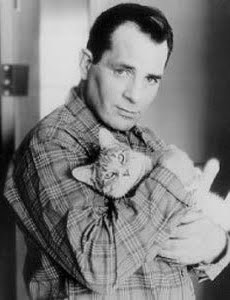 Which only exists in small form, unfortunately, so I'm not feeling as optimistic about this one. After that, there will be two or three short comics, and Maghini might exempt me from the next few regular projects to do big paintings of Ginsberg and Burroughs. Speaking of Maghini, the other day she read about how Burroughs killed his wife (I was not aware of that fact, but I'm not entirely surprised) and thought of me. I, uh? No comment...
 Which only exists in small form, unfortunately, so I'm not feeling as optimistic about this one. After that, there will be two or three short comics, and Maghini might exempt me from the next few regular projects to do big paintings of Ginsberg and Burroughs. Speaking of Maghini, the other day she read about how Burroughs killed his wife (I was not aware of that fact, but I'm not entirely surprised) and thought of me. I, uh? No comment...
 Ehhh. So, this isn't much of a book update, but guess what, this is my blog and not yours, and also I don't feel like writing a story draft for Marky Mark.
Oh, and I'm pumped about this project and can't stop talking about the damned thing. Actually, I can turn this into a book post sort of. We're reading On the Road in Robby D's, and I decided because I for some reason get very picky about my Kerouac books (ex. I didn't take the chance to get a third-edition copy of Dharma Bums because of its look and feel--displeasing compared to the copy I had first read) I'd go ahead and read my copy anyway (it's the original scroll. I'm no n00b.) I'd still read the school's copy alongside it--you know, to compare. MY FAVORITE SCENE IS CUT OUT. Actually, I kind of feel uncomfortable saying it's my favorite scene now knowing that Burroughs shot his wife in the face or whatever.
Yuuuup. In other news, I've had a very accident prone day. I was just chewing ice and the ice hit my gums on the roof of my mouth right between my two front teeth and now I'm bleeding like mad. And I slipped on the driveway walking from the mailbox. and I slid down the mini-hill thrice. And I fell on my butt when I was chasing Dante over where the pool used to be. And outside of Target I made very intimate friends with the wall. HAVE I WORKED OUT MY BAD KARMA YET??
Thursday, September 17, 2009
The universe is shaped exactly like the earth if you go straight long enough you'll end up where you were
So, my copy of On the Road is some super-special edition that's the original scroll, there's a picture of Jack Kerouac on the back (do you ever say things just because you know they'll rhyme?) and the cover feels cool and not like a smooth tile floor. Though I guess the downside is that it stains in about 30 seconds...
So, in the beginning, there were like 120 introductory forward pages and I'm over here like, "Shut up, these always just want to make me kill myself". (Could we talk about Kerouac one time without talking about his downward spiral into alcoholism and beyond?) So I skipped them. Because anyone can talk about anybody with as many insights and chronicling and notes as they want, and this blog is proof of it. So... Hire me? (No lie, people get hired for their blogs nowadays. This fact and the Lego shirt make me think the future finally has happened, though I'm sure Marky Mark would most vehemently disagree with me on that one.
Oh, and I'm teaching Kerouac the art of the paragraph even if I have to get infected with rabies and involve myself in a highly illegal and life-threatening car chase game.
"...Apparently he was f**king with her. He was always doing so." This made me laugh because it just sounded too much like Alex from Everything is Illuminated to ignore. It was worth the expletive.
"...A traveling epic Hunkey, crossing and recrossing the country every year, south in the winter and north in the summer and only because he has no place he can stay in without getting tired of it and because there's nowhere to go but everywhere." Can I taken a second to reinstate the fact that I love this man?
Oh man, there's a scene I think is incredibly beautiful. I don't why it touched me so, but hey. It's Allen Ginsberg and Neal Cassady blessing each other and making vows of "eternal friendship and love". I'd copy it down, but in whole context it's at least the two pages full, and as much as I love you guys, I like my wrists more. In this edition (The Viking edition) it's on page 161. But really, I can't do it justice; or maybe you'll read it and you won't be touched. Probably you won't be. In cases like these, it's never the same.
"'The Banana King is your meat.'" For Emma, I had to. Though, you know, it makes a lot more sense in context! (I wonder how he'd feel about Charlie the Unicorn? I saw a Charlie the Unicorn belt at the mall and thought of you...) The Banana King=a guy selling bananas, and "is your meat" is saying, he's your fodder, your inspiration, and so on. Well, I was proud of myself for 'getting it'! At least, I think I 'got it'. Why am I saying everything in quotes? Am I eighty right now?
"Ah it was a fine night, a warm night, a wine-drinking night, a moony night, and a night to hug your girl and talk and spit and be heavengoing." I love that last bit, "heavengoing". I'm not entirely sure what he means, but I think he's referring to those moments when you feel perfect, you know, when you fit in with everything in the world and it's different from ecstasy, it's more like you're pleased and humbled and feel whole and are happy for it. It doesn't have a name, so far as I know, that feeling. (In Perks of Being a Wall Flower, Charlie refers to it as being "infinite")
"Isn't it true that you start your life a sweet child believing in everything under his father's roof, then comes the day... when you know you are wretched, and miserable, and poor, and blind, and naked, with the visage of a gruesome greiving ghost you go shuddering through nightmare life." This reminds me of a quote from Doctor Zhivago I love which I can't find because Wikiquote sucks and my yellow notebook apparently got eaten by that bear that appears in the neighborhood every time I want to sleep outside. But it's basically about how when you're a child growing up it's like you're being led by the hand by someone who will protect you and care for you, but then when you're an adult, that hand suddenly leaves and you feel abandoned and alone. Lost, because you've never been in that situation before, and scared. Startled. Man, and it's so good. It's quoted in Into the Wild, too.... I am most enraged. Time to call on my fifties-era gang-member teacher to wrong this right...
"'...she's knitting my doom.'" Again, I just like how it's written. (Well, was said...) And how! Why don't I know anyone that talks like this? Sure, I'm your stereotypical Victorian/1920's speaker, but we need some of this. Anyone care to hop on the trolley? Please?
"He and I suddenly saw the whole country like an oyster for us to open; and the pearl was there, the pearl was there."
"'...because man a road like this must eventually lead to the whole world.'"
"There's always more, a little further--it never ends." I'm sure you're seeing a trend in this type.
I can't find the section I marked, but there's a part where Jack makes love to a Mexican woman whose name I can't remember, but her son Raymond watches some or part of it. It's almost exactly like the scene in Big Sur, only without being amazingly upsetting and horrifying. The sentence was like "Raymond got out of his crib and came in the room", or something like that, and nothing more. Just thought of poor little Elliot.
"'It's the world!' said Neal. 'My God!' he cried slapping the wheel. 'It's the world!'" Okay, so it reminded me a little bit of Watchmen when Rorschach's psychiatrist says to his wife, "'I can't run from it, Gloria... It's the world..." Okay, so I paraphrased a little. But no, that's not just it. It just struck my heart somehow, I guess.
Oh, I probably should have said this book has the same main idea as all his other books.
Oh, and I read Of Mice and Men by John Steinbeck. First off, I can't imagine why kids complain about having to read this in school. I have a mini edition that just screams it was printed in the seventies that's something like 120 pages. So the school editions are like... 60 pages tops? At least. Gad, what whiners. Second, it's one of the most depressing books I've ever read. But wait! Wait, I still--well, maybe 'liked' it isn't the word, but I... recognize its merit?
Thirdly, it's about these two travelers, looking for work, run out of their hometown. One, the smaller fellow (George) is of normal intelligence, a little on the small side, but besides that, he looks after his fellow traveler (Lennie), who's built like a wall. Unfortunately, his intelligence is exceptionally low. (Hence why he needs to be looked after). But he has a heart of gold, and loves animals--an overpowering love, often accidentally killing animals like mice that he pets because he doesn't know his own strength, he gets angry when they try to bite him, and because his hands are just so huge.
I also can't tell you what the point of this book was, either. On the inside, whoever owned it before me has written "Steinbeck suggests the fulfillment of dreams requires companionship", and maybe he does, but damned if I can figure out how. The end... Jeez. And "Of love and need"? God, maybe George couldn't take it anymore, maybe it's unfair to expect and demand that he continue to take, but I think he's a right slimy bastard.
"'We travel together,' said George coldly. 'Oh, so it's that way.'" I don't really get what Curley means by "that way". I would have thought he was making a jab that he thinks they're gay or some such, but I guess that doesn't really bode with the fact that he always thinks everyone is having sex with his wife, including George and Lennie.
"'He's a nice fella,' said Slim. 'Guy don't need no sense to be a nice fella.'" Yeah, George, they don't. Ugh. I hate George so much.
The scene with the old dog was forshadowing, I guess, now that I think about. I guess that was mostly the reason why George decided he had to be the one to... Ugh. Is it necessary we talk about him? Because seriously, he's a [candy-happy unicorn pony].
You know, I bet that conversation where poor Candy tries to get them not to kill his dog (to wait till tomorrow, at least, to put it off one more day) probably was the final thing that made George do it. I mean, he couldn't right continue with Lennie after the tart got... But, recalling that, when the old man's like "'Maybe tomorra. Let's wait till tomorra.'" and then Carlson says "'I don't see no reason for it...'" and pulls the pistol out then and there and takes the dog... Christ. He's slime too. Maybe the dog wasn't in the best of sorts, but really, anyone who would so eagerly kill a dog... (And not by accident. Which soumds weird if you haven't read the book, but...)
You know what, Lennie isn't a bad guy at all. He wouldn't have hurt Curly if it hadn't been for George goading him on. Maybe Curley had it coming like everyone said, but still, George, I'm egging your house. I don't even care if I have to walk all the way to CA, either.
"'Cause I'm black. They play cards in there, but I can't play because I'm black. They say I stink. Well, I tell you, you all of you stink to me.'" I think Atticus would have smiled a little at this.
I had the final scene marked but I can't write about it. George is a slimy, weak, yellow-bellied spineless clod of dirt. I can't. Sorry. It's too upsetting a scene. Poor Lennie.
To change that dour mood, Robby D remembered Everything is Illuminated. Of course, I immediately started it! Love that booook! I also finished The Illiad, which I won't be reviewing because it's weird to try and review a book that could be your 1,400-year-old father. However, when I have more time I am going to make a belated-birthday-or-something post for Emma of all the hilarious things in it. (PS. The Odyssey > The Illiad)
PS. Hello Alex! Glad you've enjoyed this madness! Hope this most recent hasn't depressed you too much!
So, in the beginning, there were like 120 introductory forward pages and I'm over here like, "Shut up, these always just want to make me kill myself". (Could we talk about Kerouac one time without talking about his downward spiral into alcoholism and beyond?) So I skipped them. Because anyone can talk about anybody with as many insights and chronicling and notes as they want, and this blog is proof of it. So... Hire me? (No lie, people get hired for their blogs nowadays. This fact and the Lego shirt make me think the future finally has happened, though I'm sure Marky Mark would most vehemently disagree with me on that one.
Oh, and I'm teaching Kerouac the art of the paragraph even if I have to get infected with rabies and involve myself in a highly illegal and life-threatening car chase game.
"...Apparently he was f**king with her. He was always doing so." This made me laugh because it just sounded too much like Alex from Everything is Illuminated to ignore. It was worth the expletive.
"...A traveling epic Hunkey, crossing and recrossing the country every year, south in the winter and north in the summer and only because he has no place he can stay in without getting tired of it and because there's nowhere to go but everywhere." Can I taken a second to reinstate the fact that I love this man?
Oh man, there's a scene I think is incredibly beautiful. I don't why it touched me so, but hey. It's Allen Ginsberg and Neal Cassady blessing each other and making vows of "eternal friendship and love". I'd copy it down, but in whole context it's at least the two pages full, and as much as I love you guys, I like my wrists more. In this edition (The Viking edition) it's on page 161. But really, I can't do it justice; or maybe you'll read it and you won't be touched. Probably you won't be. In cases like these, it's never the same.
"'The Banana King is your meat.'" For Emma, I had to. Though, you know, it makes a lot more sense in context! (I wonder how he'd feel about Charlie the Unicorn? I saw a Charlie the Unicorn belt at the mall and thought of you...) The Banana King=a guy selling bananas, and "is your meat" is saying, he's your fodder, your inspiration, and so on. Well, I was proud of myself for 'getting it'! At least, I think I 'got it'. Why am I saying everything in quotes? Am I eighty right now?
"Ah it was a fine night, a warm night, a wine-drinking night, a moony night, and a night to hug your girl and talk and spit and be heavengoing." I love that last bit, "heavengoing". I'm not entirely sure what he means, but I think he's referring to those moments when you feel perfect, you know, when you fit in with everything in the world and it's different from ecstasy, it's more like you're pleased and humbled and feel whole and are happy for it. It doesn't have a name, so far as I know, that feeling. (In Perks of Being a Wall Flower, Charlie refers to it as being "infinite")
"Isn't it true that you start your life a sweet child believing in everything under his father's roof, then comes the day... when you know you are wretched, and miserable, and poor, and blind, and naked, with the visage of a gruesome greiving ghost you go shuddering through nightmare life." This reminds me of a quote from Doctor Zhivago I love which I can't find because Wikiquote sucks and my yellow notebook apparently got eaten by that bear that appears in the neighborhood every time I want to sleep outside. But it's basically about how when you're a child growing up it's like you're being led by the hand by someone who will protect you and care for you, but then when you're an adult, that hand suddenly leaves and you feel abandoned and alone. Lost, because you've never been in that situation before, and scared. Startled. Man, and it's so good. It's quoted in Into the Wild, too.... I am most enraged. Time to call on my fifties-era gang-member teacher to wrong this right...
"'...she's knitting my doom.'" Again, I just like how it's written. (Well, was said...) And how! Why don't I know anyone that talks like this? Sure, I'm your stereotypical Victorian/1920's speaker, but we need some of this. Anyone care to hop on the trolley? Please?
"He and I suddenly saw the whole country like an oyster for us to open; and the pearl was there, the pearl was there."
"'...because man a road like this must eventually lead to the whole world.'"
"There's always more, a little further--it never ends." I'm sure you're seeing a trend in this type.
I can't find the section I marked, but there's a part where Jack makes love to a Mexican woman whose name I can't remember, but her son Raymond watches some or part of it. It's almost exactly like the scene in Big Sur, only without being amazingly upsetting and horrifying. The sentence was like "Raymond got out of his crib and came in the room", or something like that, and nothing more. Just thought of poor little Elliot.
"'It's the world!' said Neal. 'My God!' he cried slapping the wheel. 'It's the world!'" Okay, so it reminded me a little bit of Watchmen when Rorschach's psychiatrist says to his wife, "'I can't run from it, Gloria... It's the world..." Okay, so I paraphrased a little. But no, that's not just it. It just struck my heart somehow, I guess.
Oh, I probably should have said this book has the same main idea as all his other books.
Oh, and I read Of Mice and Men by John Steinbeck. First off, I can't imagine why kids complain about having to read this in school. I have a mini edition that just screams it was printed in the seventies that's something like 120 pages. So the school editions are like... 60 pages tops? At least. Gad, what whiners. Second, it's one of the most depressing books I've ever read. But wait! Wait, I still--well, maybe 'liked' it isn't the word, but I... recognize its merit?
Thirdly, it's about these two travelers, looking for work, run out of their hometown. One, the smaller fellow (George) is of normal intelligence, a little on the small side, but besides that, he looks after his fellow traveler (Lennie), who's built like a wall. Unfortunately, his intelligence is exceptionally low. (Hence why he needs to be looked after). But he has a heart of gold, and loves animals--an overpowering love, often accidentally killing animals like mice that he pets because he doesn't know his own strength, he gets angry when they try to bite him, and because his hands are just so huge.
I also can't tell you what the point of this book was, either. On the inside, whoever owned it before me has written "Steinbeck suggests the fulfillment of dreams requires companionship", and maybe he does, but damned if I can figure out how. The end... Jeez. And "Of love and need"? God, maybe George couldn't take it anymore, maybe it's unfair to expect and demand that he continue to take, but I think he's a right slimy bastard.
"'We travel together,' said George coldly. 'Oh, so it's that way.'" I don't really get what Curley means by "that way". I would have thought he was making a jab that he thinks they're gay or some such, but I guess that doesn't really bode with the fact that he always thinks everyone is having sex with his wife, including George and Lennie.
"'He's a nice fella,' said Slim. 'Guy don't need no sense to be a nice fella.'" Yeah, George, they don't. Ugh. I hate George so much.
The scene with the old dog was forshadowing, I guess, now that I think about. I guess that was mostly the reason why George decided he had to be the one to... Ugh. Is it necessary we talk about him? Because seriously, he's a [candy-happy unicorn pony].
You know, I bet that conversation where poor Candy tries to get them not to kill his dog (to wait till tomorrow, at least, to put it off one more day) probably was the final thing that made George do it. I mean, he couldn't right continue with Lennie after the tart got... But, recalling that, when the old man's like "'Maybe tomorra. Let's wait till tomorra.'" and then Carlson says "'I don't see no reason for it...'" and pulls the pistol out then and there and takes the dog... Christ. He's slime too. Maybe the dog wasn't in the best of sorts, but really, anyone who would so eagerly kill a dog... (And not by accident. Which soumds weird if you haven't read the book, but...)
You know what, Lennie isn't a bad guy at all. He wouldn't have hurt Curly if it hadn't been for George goading him on. Maybe Curley had it coming like everyone said, but still, George, I'm egging your house. I don't even care if I have to walk all the way to CA, either.
"'Cause I'm black. They play cards in there, but I can't play because I'm black. They say I stink. Well, I tell you, you all of you stink to me.'" I think Atticus would have smiled a little at this.
I had the final scene marked but I can't write about it. George is a slimy, weak, yellow-bellied spineless clod of dirt. I can't. Sorry. It's too upsetting a scene. Poor Lennie.
To change that dour mood, Robby D remembered Everything is Illuminated. Of course, I immediately started it! Love that booook! I also finished The Illiad, which I won't be reviewing because it's weird to try and review a book that could be your 1,400-year-old father. However, when I have more time I am going to make a belated-birthday-or-something post for Emma of all the hilarious things in it. (PS. The Odyssey > The Illiad)
PS. Hello Alex! Glad you've enjoyed this madness! Hope this most recent hasn't depressed you too much!
Subscribe to:
Posts (Atom)